

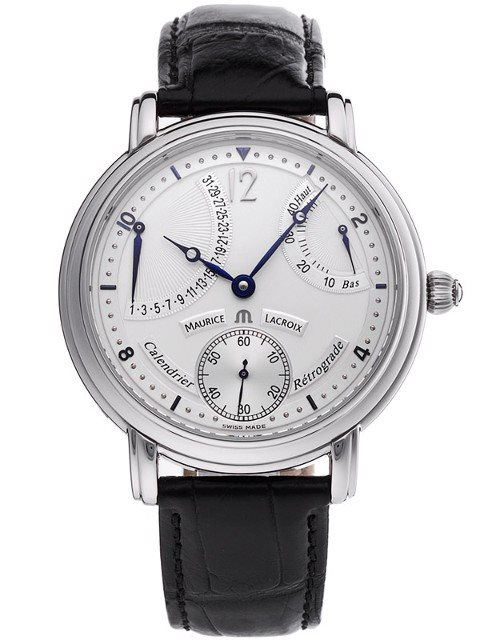
Masterpiece
Line History
The line was born in 1990 under the name "Les Mécaniques," conceived from the start as the most ambitious showcase of the Maurice Lacroix catalog: mechanical watches with visible complications, meant to signal to the market that the brand was not just a maker of affordable watches, but a company capable of competing in the field of haute horlogerie. In 1992 the collection was renamed Masterpiece, the name by which it is still known today. The first executions of the 1990s looked mainly to classic tradition: gold or two-tone cases, worked white dials, a rather conservative aesthetic language that over the course of the 2000s was progressively updated toward a more contemporary image, more consistent with the brand's actual price positioning.
The decisive qualitative leap came starting in the 2010s, when the Masterpiece became the ground on which Maurice Lacroix experimented with complications that were unusual and visually spectacular rather than simply expensive. In 2010 the Masterpiece Roue Carrée Seconde debuted, the world's first watch to replace the seconds hand with a gear with squared rather than rounded teeth — a result made possible by the precision of the machine tools at its subsidiary Manufacture des Franches-Montagnes. These were followed, in 2013, by the Masterpiece Mysterious Seconds, with a seconds disc that appears to float with no visible support, and in 2014 by the Masterpiece Gravity, which introduces silicon escapement components.
Behind these complications there is almost never a movement developed from scratch, but a philosophy that the brand itself describes as "working intelligently": the ML106 caliber that equips the first chronograph executions stems from a modification of the Venus 175 carried out together with independent watchmaker Andreas Strehler (jokingly nicknamed "the owl movement" for the layout of its counters); the ML291 caliber of the Triple Retrograde, instead, starts from a Sellita SW200-1 base, extensively reworked with additional modules. It is an approach that allows Maurice Lacroix to offer haute horlogerie complications — square wheels, mysterious seconds, multiple retrogrades — at a price that remains in the thousands, not the tens of thousands, of Swiss francs, confirming the brand's reputation as one of the best value propositions in complicated Swiss watchmaking.
Technical Specifications
Main Executions
The Masterpiece Roue Carrée Seconde was the world's first watch to use a non-circular gear in place of the traditional seconds wheel: a solution that industry observers have called visually even more mesmerizing than a tourbillon, made possible only thanks to the precision machinery of the components manufacture that Maurice Lacroix controls directly in the Swiss Jura.