

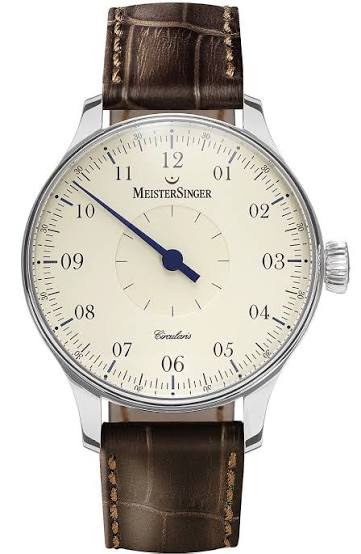
Circularis
Model History
Introduced in 2014, the Circularis marks a turning point in MeisterSinger's history: it is the brand's first model to house an internally developed caliber, the MSH01, the result of a long collaboration with a specialized Swiss partner (Synergies Horlogères, today part of the Christopher Ward group). Until then, MeisterSinger had built its identity on the single-hand philosophy applied to supplied movements (first ETA, then Sellita); with the Circularis the brand showed it could carry the same philosophy onto a movement of its own manufacture.
The heart of the Circularis is a manually wound caliber with two barrels in series, a solution that allows for a power reserve of 120 hours, or five days — a notable figure for a movement of this class, achieved without sacrificing the 28,800 vibrations/hour (4 Hz) frequency typical of precision calibers. The finishing, with circular polishing, mirror-polished bevels and blued screws on a rhodium-plated movement, signals the brand's ambition to position this line in a higher tier than the rest of the catalog.
Aesthetically the Circularis keeps MeisterSinger's founding principle intact — a single hand for hours and minutes, dial numbered from 01 to 12 — but presents it in a 43 mm case designed to showcase the movement's finishing, visible through the sapphire caseback. Over time the line has been enriched with variants featuring additional complications consistent with the same philosophy, such as a power reserve indicator, always resolved without adding a second, independent hand for hours and minutes.
Technical Specifications
Main Executions
The name "Circularis" recalls both the circular shape of the dial and the circular motion of the single hand that travels around it entirely over twelve hours: a linguistic play consistent with MeisterSinger's habit of choosing names that tell the brand's philosophy more than the watch's plain aesthetics.