

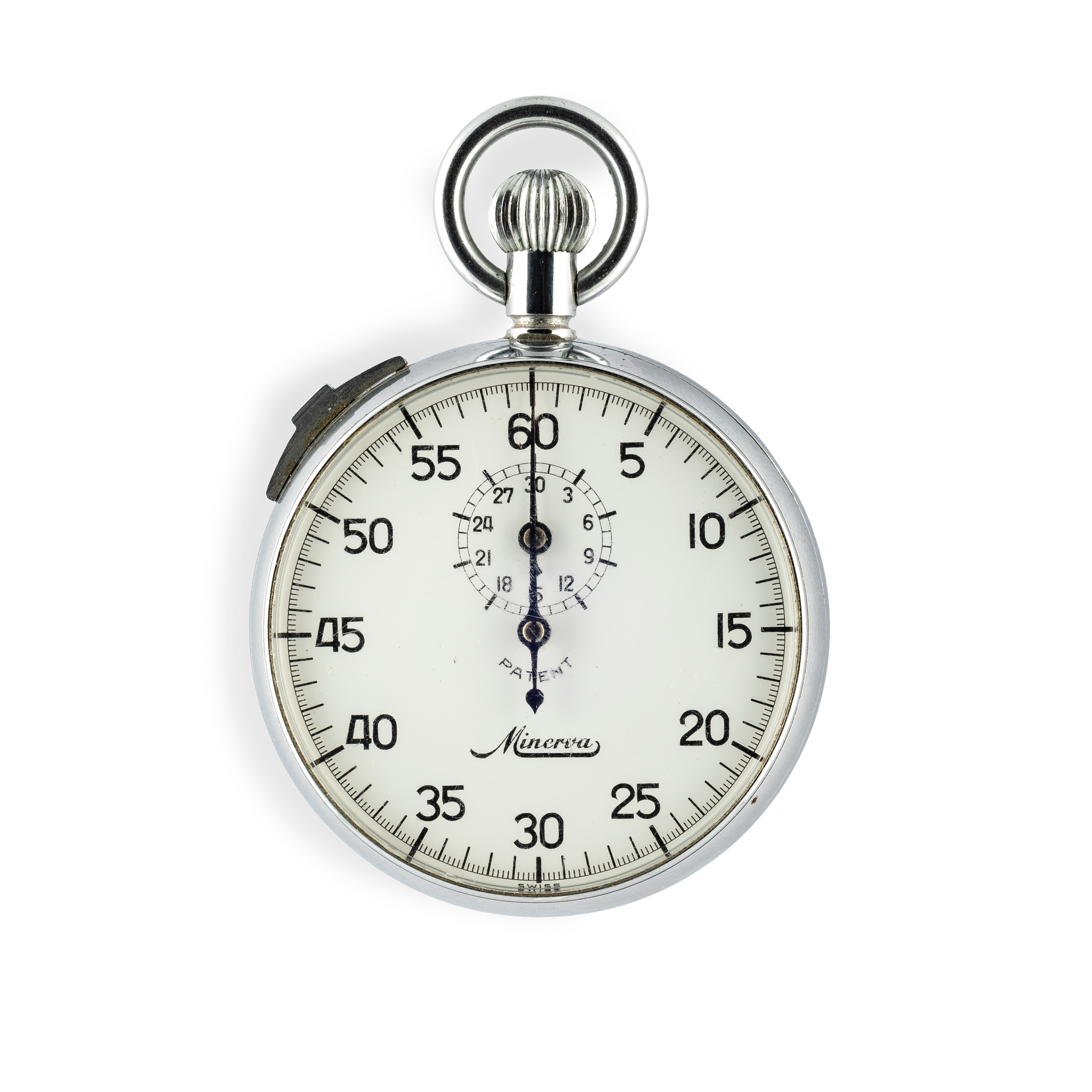
Pocket and Table Chronometers
Line History
Alongside wrist chronographs, for much of the twentieth century a significant share of Minerva's activity consisted of producing pocket and table chronometers for precision timekeeping: instruments designed for the world of sport, where measuring fractions of a second became essential, and for military and aeronautical uses, where ruggedness and reliability mattered as much as measurement accuracy.
These chronometers, often based on the 19-9 calibre family and its split-seconds evolutions, were made both under the Minerva name and, in many cases, supplied to other major watchmaking maisons and to sporting bodies that needed high-level timekeeping instrumentation: a role as reference supplier that is still remembered today as one of the pillars of the Villeret manufacture's technical reputation.
It is precisely on this solid foundation of timekeeping expertise that, in 1998, Minerva produced a mechanical chronograph capable of measuring 1/100 of a second, running at 360,000 vibrations per hour, a result that entered the Guinness World Records and demonstrates how the experience built up with pocket and table chronometers continued to fuel the manufacture's innovation until the years immediately preceding its acquisition by Richemont.
Technical Specifications
Main Executions
In 1998 a mechanical Minerva chronograph capable of measuring 1/100 of a second, running at 360,000 vibrations per hour, entered the Guinness World Records: a result rooted precisely in the manufacture's long experience building precision chronometers for sport.