

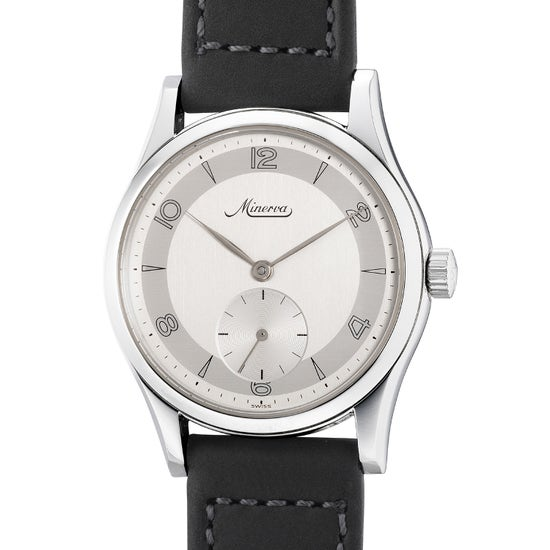
Pythagore
Line History
The Pythagore was born in 1943 from the insight of watchmaker André Frey, who designed the manual calibre 10-48 by arranging wheels, bridges and regulating organs according to the golden ratio, the 1.618 proportion already dear to classical architecture and painting. This was not a functional choice but a purely aesthetic one: a movement designed to be observed through a transparent case back, at a time when most dress watches hid their mechanics behind closed cases.
The name, a clear homage to the Greek mathematician and philosopher Pythagoras, has since accompanied one of the calibre families most often cited when discussing the finishing and aesthetic composition of mechanical movements. Over the decades Minerva has offered several executions of the Pythagore, in gold or steel, always keeping the movement's characteristic geometric layout as the line's distinguishing feature.
Unlike the chronographs that made the Minerva name famous in the twentieth century, the Pythagore represents the manufacture's more classical, contemplative side: a dress watch designed for collectors and enthusiasts of high watchmaking, still remembered and sought after today as one of the purest expressions of independent watchmaking aesthetics before Minerva's entry into Richemont.
Technical Specifications
Main Executions
The Pythagore calibre is among the mechanical movements most often cited as an example of "watchmaking architecture": the arrangement of its components responds to no technical necessity, but to a purely compositional criterion inspired by classical geometry, visible and appreciable only thanks to the case's transparent back.