

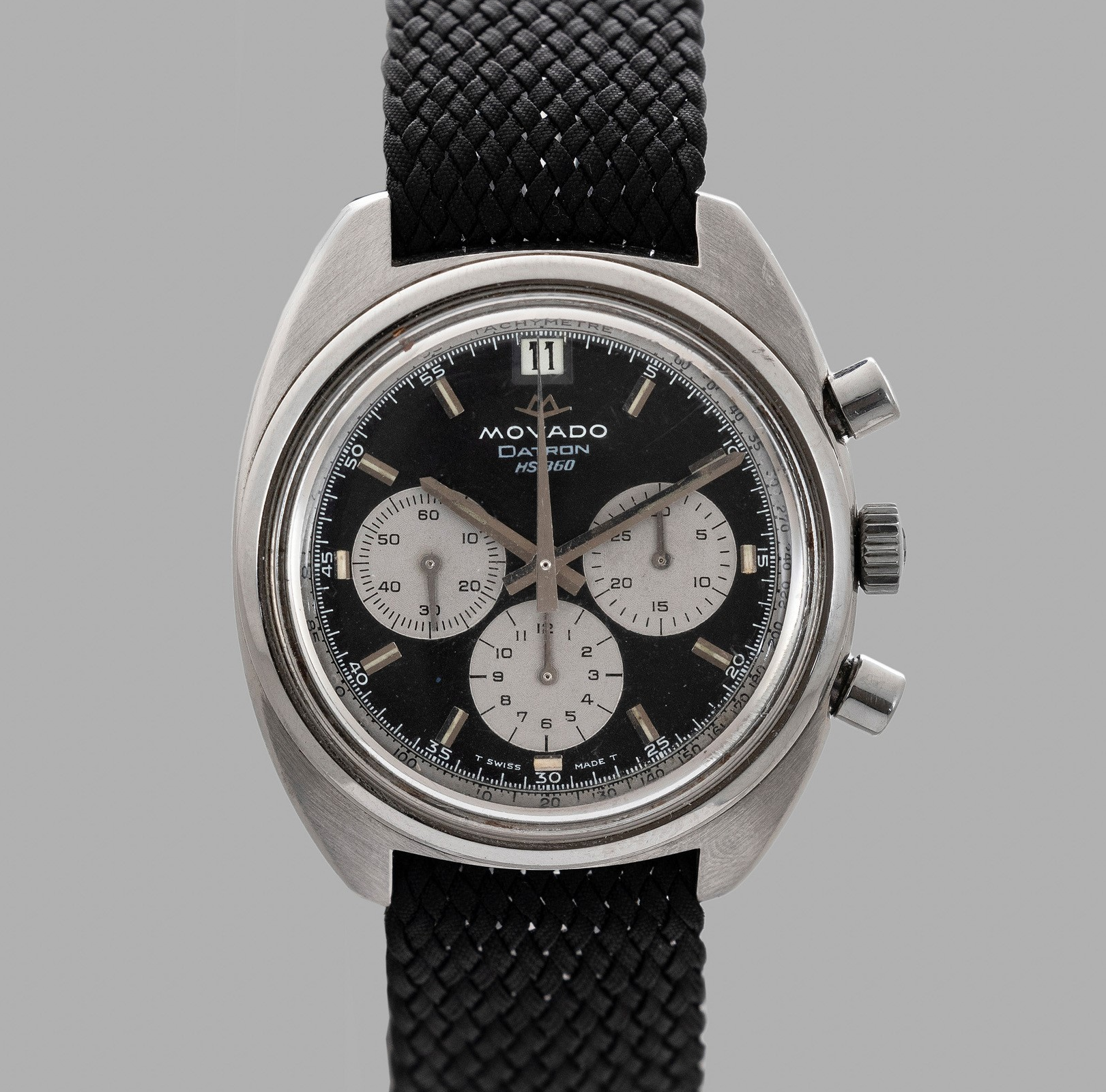
Datron
Model History
1969 is one of the most hotly contested years in the history of Swiss watchmaking: three rival groups race in parallel, not knowing for certain of one another, to present the world's first automatic chronograph movement. On the first front is the consortium formed by Heuer, Breitling, Büren and Dubois Dépraz, which develops the Caliber 11, marketed under the name Chronomatic. On the second front, Japan's Seiko works independently on caliber 6139. On the third front, an alliance forms instead between Zenith, Movado and Mondia: it is Zenith that technically develops the movement, which will be christened "El Primero" — "the first," in Spanish, a name that would prove almost prophetic — while Movado markets it under its own name, the Datron HS 360. Movado's role in this story remains essentially commercial rather than inventive: it is not Movado that designs the caliber, but the brand still becomes one of the three public faces at the historic moment when the Swiss industry demonstrates, in the very year of the advent of the Japanese quartz watch, that it still knows how to innovate on the ground of pure mechanics.
The caliber 3019PHC that powers the Datron HS 360 is, technically, a high-frequency automatic movement — 36,000 vibrations per hour, equal to 5 Hz, against the 4 Hz then common — that guarantees chronographic timing precision down to a tenth of a second, a distinction that would remain associated with the El Primero name throughout its subsequent history, including collaborations with other brands in the years to come. The Datron HS 360 cases, in 38 mm steel, house the Zenith caliber with dials that, in the versions most sought after by today's collectors, show a characteristic "tropical" patina on a blue background, developed naturally over time from exposure to light — a detail that, far from being a flaw, has become one of the reasons these examples are sought after today on the vintage market. It is significant that that same 1969 also marks the corporate merger between Movado and Zenith: the Datron is thus born exactly at the moment of transition in which the two maisons, independent until then, join their industrial fates for the first time.
The very survival of the El Primero caliber, and with it the Datron's legacy, was by no means guaranteed: a few years after its launch, the quartz crisis of the 1970s leads Zenith to consider permanently closing down production of mechanical movements, with orders to dismantle the El Primero's tooling and assembly lines. According to Zenith's own account, it was a technician at the manufacture, Charles Vermot, who secretly hid plans, tools and components in the factory's attics, thereby preserving the possibility of putting the caliber back into production when, in the 1980s, traditional mechanics came back into fashion. Without that rescue, today not only Zenith's El Primero but also the Datron chapter of Movado's history would have remained a closed episode without heirs, rather than one of the strongest bridges linking the brand to the great history of twentieth-century Swiss mechanical watchmaking.
Technical Specifications
Main Executions
"El Primero" literally means "the first" in Spanish: a name chosen by Zenith to claim primacy in the 1969 race for the automatic chronograph, one the caliber might not have deserved at all had a technician at the manufacture not secretly hidden the production tooling during the quartz crisis, saving the movement — and with it, indirectly, the legacy of the Movado-branded Datron as well — from a closure that had seemed already decided.