

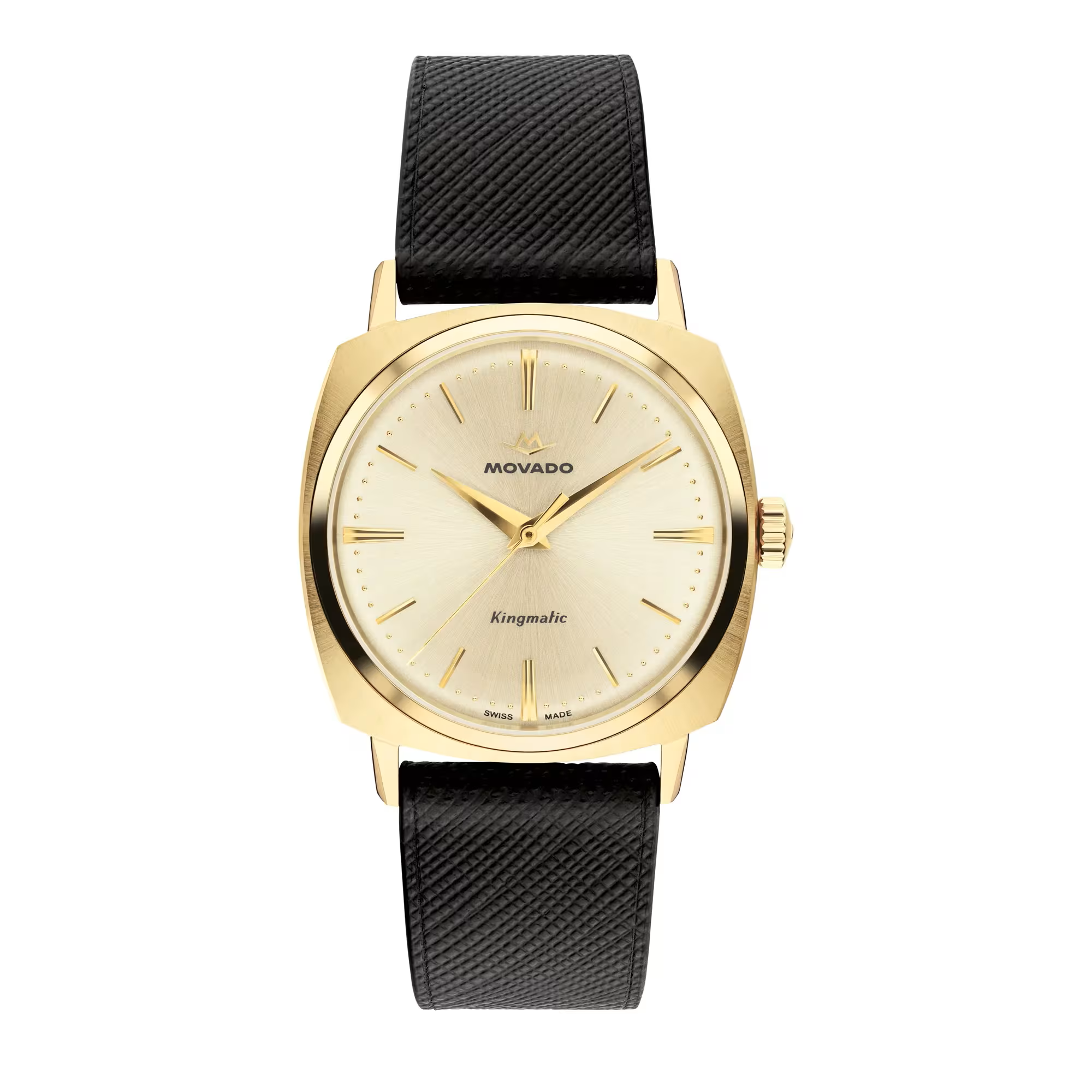
Model History
The Kingmatic debuts in 1956 as Movado's response to a phenomenon that was then sweeping through all of Swiss high watchmaking: the boom in elegant automatic men's watches in the decade following the Second World War, when hand-winding was beginning to seem an outdated constraint for anyone seeking a representative wristwatch. Unlike many competitors, who relied on outside suppliers for their automatics, Movado equips the Kingmatic with calibers entirely developed and produced in-house: a family of 28-jewel automatic movements that over the years comprises the initial caliber 115 "Futuramic" and the subsequent evolutions 388, 389, 395, 408, 431, 531, up to the 538 "Kingmatic Calendoplan" fitted with a calendar. This is no small detail: in the same period Movado files, according to historical industry accounts, nearly 98 Swiss patents between 1900 and 1969, proof of an autonomous manufacturing capability few brands in that bracket could claim.
The variant most sought after by today's collectors is the Kingmatic Sub-Sea, equipped with water-resistant cases made by François Borgel, the same Swiss specialist in watertight cases that, in the same period, Patek Philippe also relied on for some of its sports models. The Borgel cases of the Kingmatic Sub-Sea carry on the inside of the case back a characteristic "FB" marking, today one of the details vintage-watch experts check to authenticate their origin. The Kingmatic thus represents, more than any other model in Movado's historical catalogue, the highest point reached by the brand as a vertically independent manufacture: an era that closes abruptly in 1969, when the corporate merger with Zenith marks the beginning of a new chapter, less tied to in-house production of proprietary calibers.
The Kingmatic name has remained so firmly in the brand's memory that it was chosen, in 2026, as the protagonist of the celebrations for Movado's 145th anniversary: the Heritage Kingmatic, presented on that occasion, revives the cushion-shaped case silhouette typical of the early 1960s, in a more compact 35 mm diameter, with a sapphire display case back to admire the movement — this time a third-party caliber, the Sellita SW200-1 — and a black dial with applied indexes in vintage style. It is a rare case in the Movado catalogue in which a 1950s model is revived not as a mere aesthetic citation but as a genuine, declared reissue, capable of directly connecting the golden age of independent manufacturing to the brand's present.
Technical Specifications
Main Executions
The water-resistant cases of the Kingmatic Sub-Sea came from the same workshop, that of François Borgel, which in those same years Patek Philippe also relied on for some of its sports watches: a detail few people associate with the Movado name today, but one that testifies to how solid, before the 1969 merger with Zenith, the network of top-tier suppliers the brand could access as a fully independent manufacture really was.