

Museum Watch
Model History
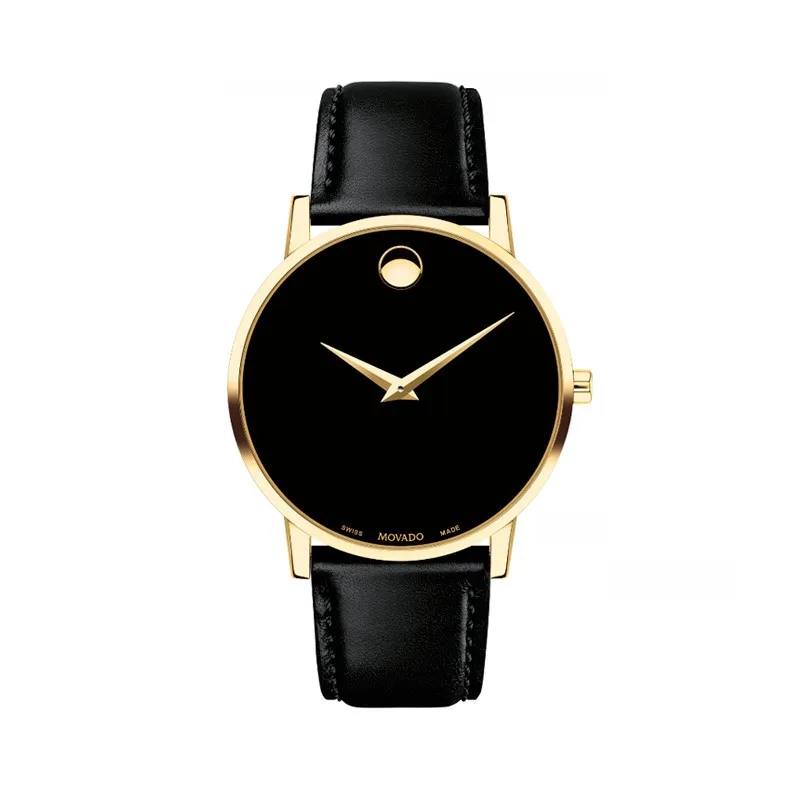
In 1947 the modernist designer Nathan George Horwitt, an American of Russian origin active in New York, proposes to Movado a dial that breaks with every watchmaking convention up to that point: no numerals, no seconds hand, no decoration — only an absolute black surface interrupted by a single golden dot positioned exactly at 12 o'clock. The meaning is stated by Horwitt himself: that dot represents the sun at the moment it reaches its zenith, at noon, bringing the measurement of time back to its most ancient origin, the sundial. The design philosophy guiding Horwitt is summed up in a phrase the designer often repeats: "Without use, there is no beauty — without beauty, what is the use?" — a minimalist manifesto that anticipates by decades trends that would become mainstream in industrial design only much later.
Decisive recognition arrives in 1960: the dial designed by Horwitt becomes the first watch dial to be admitted into the permanent collection of the Museum of Modern Art in New York, an institution that until then had never considered a watch component a design object worthy of museum preservation. From that moment the model, produced by Movado, is simply renamed "Museum Watch" or "Museum Dial," a name that still accompanies every reissue today. The story, however, also has a less celebrated side: Horwitt, who had registered the design as his own industrial patent as early as 1953, finds himself having to assert the rights to his creation when other brands begin reproducing dials in a very similar style. The dispute with Movado, which had meanwhile marketed the design widely, is resolved only in 1975 with a financial settlement — around 29,000 dollars paid to Horwitt — that formally closes the question of rights over the icon the brand had made famous worldwide.
In the following decades the Museum Watch stops being a single model and becomes a true permanent collection within the Movado catalogue, today known as Museum Classic: the case has evolved from more compact shapes to the more generous 40 mm diameters common today, the movements have largely shifted to Swiss quartz, and the original black dial has been joined by variants with diamond indexes, bicolor steel-and-gold cases, and even women's versions with more compact dimensions. What has never changed, in over seventy years of almost uninterrupted production, is the golden dot at 12 o'clock: the element that makes the Museum Watch instantly recognizable and that remains, even today, the most identifiable design icon of the entire Movado brand.
Technical Specifications
Main Executions
The golden dot at 12 o'clock is not an aesthetic flourish: it literally represents the sun at the moment of zenith, at noon, in a reference Horwitt himself declared to the sundial as the ancestor of every timekeeping instrument. It is also one of the very few cases in the history of industrial watchmaking in which New York's MoMA has recognized a dial — a technical component designed for mass production — as a design work worthy of a modern art museum's permanent collection, alongside chairs, lamps and other design icons of the twentieth century.