

Line History
The Terrasport brings into Mühle-Glashütte's contemporary catalogue a lesser-known but ancient chapter of the brand's history: as early as the late 1930s, the Mühle family's precision workshop had begun making, besides more generic wrist instruments, watches designed for aviation, at a time when the pocket watch was gradually giving way to the more practical wristwatch even in the aeronautical environment linked to the Glashütte watchmaking tradition, begun in 1845. The Terrasport explicitly picks up that historical thread, translating into a contemporary key the same three principles the brand has always associated with the maritime world through the S.A.R. line: precision, reliability and legibility, here transferred "from water to air".
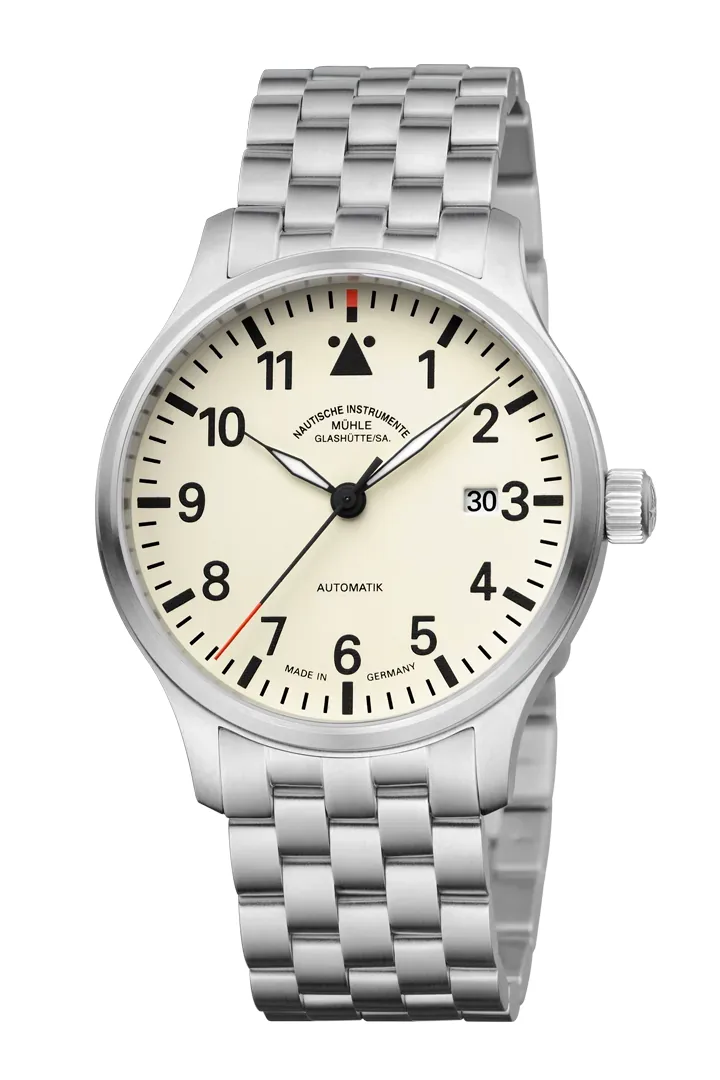
The collection's aesthetic language is that typical of historic pilot's watches: high-contrast dials designed to be read at a glance even in difficult conditions, a triangular index at 12 o'clock — an identifying element that for decades has helped pilots quickly orient themselves on the dial even with just a quick glance — and tapered, harmonious lozenge-shaped hands. The seconds hand, with its tip colored red to coordinate with the 12 o'clock index, further reinforces the overall immediate legibility, while the luminescent treatment on indexes and hands ensures visibility even in a poorly lit cockpit.
The collection has expanded over time into various generations and variants — from the Terrasport I, with its black-dial Chronograph, to the more compact Terrasport II, up to special editions such as the bronze Terrasport IV — while maintaining an underlying stylistic coherence that makes the line immediately recognizable as a product of the European pilot's-watch tradition, filtered through the brand's Saxon sensibility.
Technical Specifications
Main Executions
The triangular index at 12 o'clock that characterizes the Terrasport is the same graphic element that, since the earliest twentieth-century military pilot's watches, let aviators instantly identify the dial's orientation even with just a quick glance down at their wrist, without diverting attention from the controls: a functional detail born in the cockpit that over time became a recognized aesthetic code throughout aviator watchmaking.