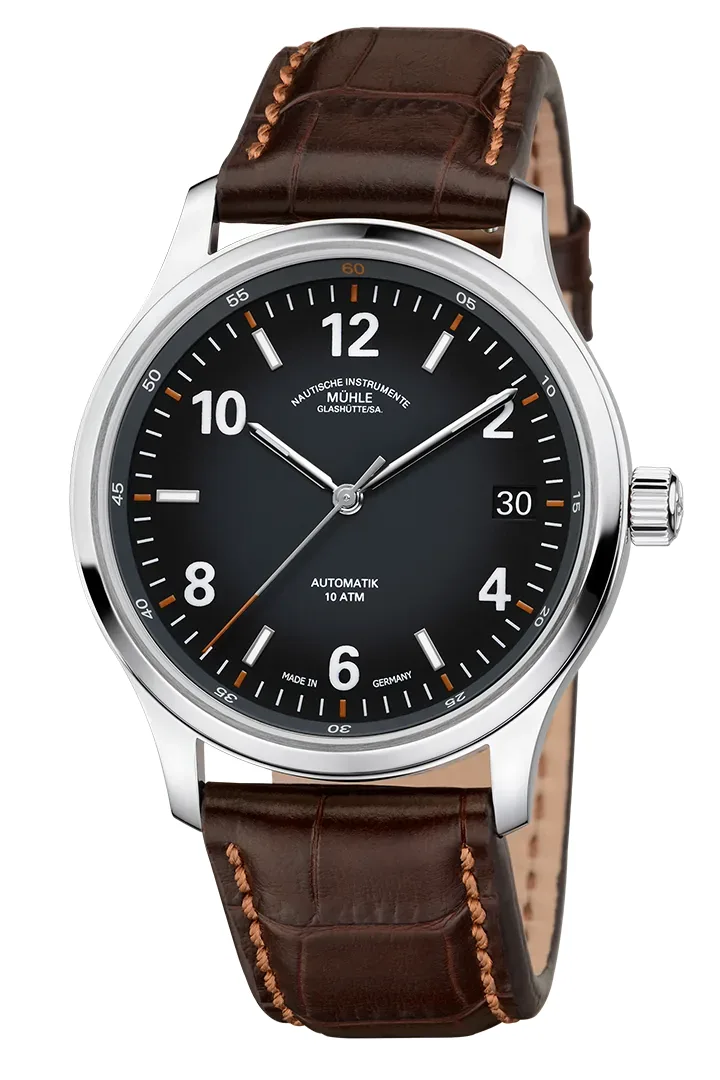

Mühle Glashütte
Brand History
The story of Mühle Glashütte begins on April 22, 1869, when Robert Mühle opens in Glashütte, in the Saxon Ore Mountains, a precision mechanics workshop. The business is not born as a watchmaking manufacture in the proper sense, but as a supplier to the local manufactures and watchmaking school: Robert Mühle builds extremely high-precision measuring instruments — including tachometers and rev counters — essential for calibrating the machine tools with which Glashütte's watchmakers worked according to the metric system, distinct from the standards used in nearby Switzerland. For these innovations he receives in 1896 the gold medal of the city of Dresden. From 1905, with the entry of his sons Paul, Max and Alfred, the company becomes "R. Mühle & Sohn" and expands its scope into automotive instrumentation, supplying tachometers and rev counters to brands such as Horch, DKW, BMW and Maybach: know-how in measuring motion that, decades later, would prove a natural premise for future watchmaking production.
The Second World War and the Soviet occupation abruptly interrupt this continuity: the company is expropriated and its machinery dismantled. In December 1945 Hans Mühle, the founder's grandson, re-establishes the business as "Ing. Hans Mühle," returning to the production of precision components for measuring instruments. The relief is short-lived: in 1972 a second nationalization turns the enterprise into the state-owned "VEB Feinmechanik Glashütte," with Hans-Jürgen Mühle — the founder's great-grandson — as plant director; in 1980 the company is absorbed into the large state conglomerate VEB Glashütter Uhrenbetriebe (GUB), the same one that gathered under a single name the entire watchmaking tradition of the town, born in 1845 with Ferdinand Adolph Lange.
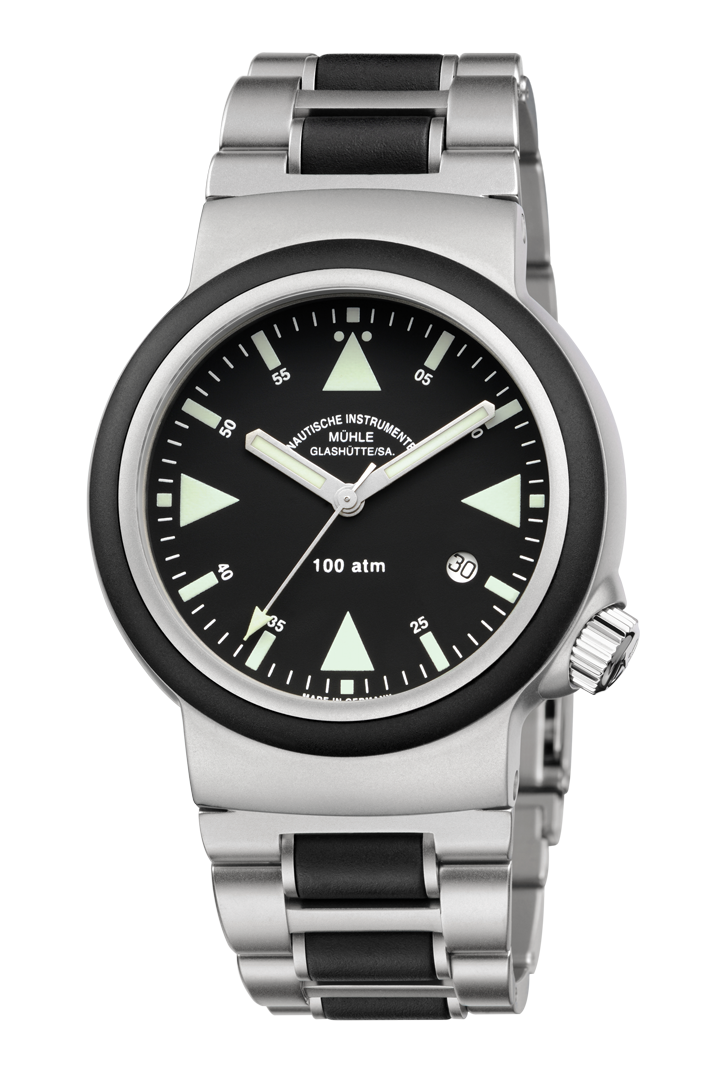
With German reunification in 1990, Hans-Jürgen Mühle takes part in transforming the GUB into a market-economy company, before leaving it to take back the family name. On April 1, 1994, he founds Mühle-Glashütte GmbH, initially dedicated to nautical instruments and marine chronometers — a production the GUB, by then focused on wristwatches, had abandoned. It is the demand from shipyards and ship owners that pushes the company, from 1996, toward its first step into wristwatches, with the "Herren-Sporttaucher-Uhr" and the "Marinefliegeruhr-I": watches conceived from the outset for professional use at sea, in direct continuity with the house's instrumental vocation.
The brand's most identifying technical leap arrives in 2003, with the development of the "woodpecker neck" regulator (Woodpecker Neck Regulator), designed to overcome the limits of the traditional swan-neck regulator of Glashütte tradition. The mechanism, patented by the company, allows a fine and repeatable adjustment of the balance's amplitude while remaining much more shock-resistant than the classic swan neck, thanks to an elastic structure resembling, precisely, the motion of a woodpecker's beak. Having become over the years a visible mark of recognition on an open case back across most Mühle calibers, the Woodpecker Regulator remains today the brand's most cited technical contribution to the history of Glashütte watchmaking.
The family's fifth generation, Thilo Mühle (b. 1968), joins the company in 2000 and becomes its sole managing director in 2007, guiding it through the global financial crisis and the development of proprietary in-house calibers, including the automatic MU 9408 and MU 9411. Since 2018 and 2021 respectively, Dustin and Fanny Mühle, the family's sixth generation, have also joined the company, taking on production responsibilities since 2024. Today Mühle-Glashütte has around 65 employees and claims a particular distinction: it is the only Glashütte manufacture still owned by a family originally from the town, alongside — but with a distinct industrial history — the brands A. Lange & Söhne and Glashütte Original, the other two great names representing today's Saxon watchmaking tradition.