

Teutonia
Line History
The Teutonia debuts in the early months of 2002, under the guidance of Thilo Mühle, then head of product development, and immediately becomes the catalogue's most identifying line. The name itself — which evokes Germany in an almost solemn form — anticipates its creators' declared intent: to make, as Thilo Mühle himself recounted, "a sporty and elegant watch, a bit German, characterized by good functionality and a no-frills approach." The first version, with a guilloché argenté dial and a big date, meets with immediate success: over 2,500 examples sold before it was replaced, already in the autumn of that same 2002, by an updated version.
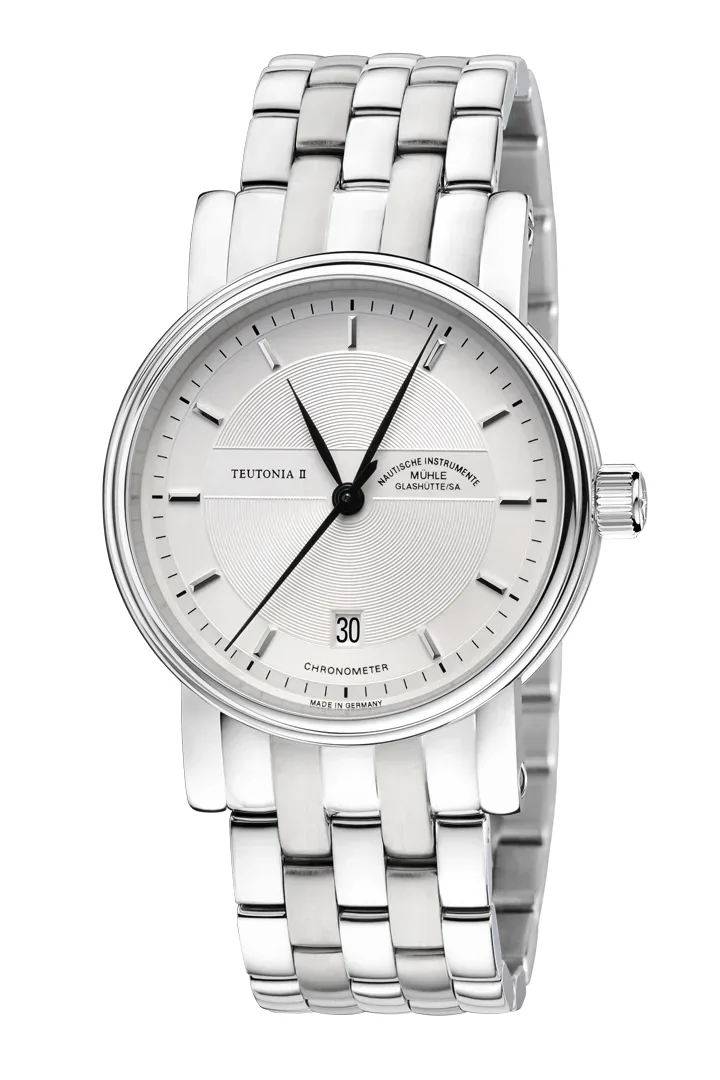
In 2005 comes the Teutonia II, which expands the line into a family of four models including Chronograph, Chronometer and the more compact-diameter Medium version: all share the raised silvered dial (a concentric-line motif achieved by milling) and the characteristic "scroll" lugs, hand-worked in their central section with vertical cuts that remain one of the brand's most recognizable aesthetic signatures. The Chronometer and Chronograph versions of the Teutonia II also integrate the Woodpecker regulator, visible through the open case back, which here becomes one of the line's most frequently cited selling points.
The following years see a progressive aesthetic refinement: the Teutonia II Kleine Sekunde (small seconds) introduces in 2015 a midnight-blue dial, while the current Teutonia IV generation adopts a thinner, faceted bezel and a fine-grained dial, in keeping with a more minimal contemporary taste compared with the early versions. In 2024, to celebrate thirty years since the brand's 1994 refounding, Mühle-Glashütte presented the Teutonia IV Big Date Edition 1994, a direct tribute to the original 2002 Teutonia through the return of the big date that had characterized the original model. Today the Teutonia remains, by the brand's own admission, the most commercially successful family of models and the true stylistic manifesto of the Saxon manufacture.
Technical Specifications
Main Executions
The name "Teutonia" refers to the Teutons, an ancient Germanic people often evoked as a poetic synonym for Germany itself: a choice that openly reflects the line's creators' intention to make a watch recognizable as "German" starting from the name itself, even before the dial's design or the case's shape.