

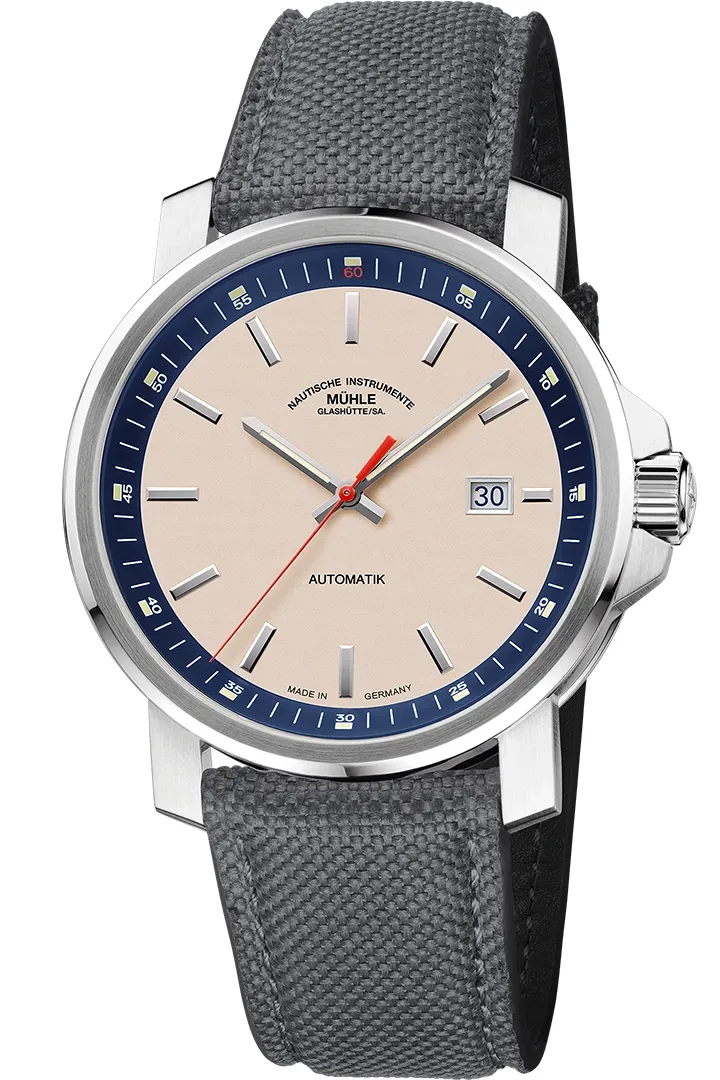
Line History
The 29er owes its name to a sailing dinghy class, the 29er, with which young sailors in Germany compete in the youth category of the championships of the German Sailing Federation (Deutscher Segler-Verband). It is an unusual origin for a watch name, but consistent with the bond Mühle-Glashütte claims with the world of sailing ever since its 1994 refounding, when the company returned to producing marine chronometers and nautical instruments even before making its first wristwatch.
In designing the line, Mühle deliberately chose to "take the speed out" of the small racing dinghy's character in order to prioritize precision instead: a concept that translates into a sporty yet composed aesthetic language, far removed from the aggressiveness typical of many regatta watches. The case surfaces alternate satin and polished finishes, the crown is protected by side guards that reduce its exposure to impacts, and the dial is organized on two levels — an inner scale with the hour indexes and an outer ring with the minute scale — to guarantee a quick, unambiguous reading even in conditions of poor visibility.
Over time the 29er family has been enriched with numerous variants covering most of the functions required of an everyday sports watch: from the base three-hand model with date, to the larger-diameter 29er Big, up to the Casual versions (more formal in finish), the Big GMT with second time zone, the Big Small Second with small seconds, the Chronograph with timing function, and the Day/Date and pointer-date (Zeigerdatum) variants. This breadth of offering has made the 29er, together with the Teutonia, one of the longest-running and best-selling families in the brand's current catalogue.
Technical Specifications
Main Executions
The nautical 29er from which the watch takes its name is by no means a slow boat: it is a high-performance planing dinghy, highly technical and widespread in youth championships. Mühle-Glashütte playfully chose to reverse its character, "subtracting" speed from the concept to turn it into a watch that favors instrumental precision over the sporting quickness of the craft that gives it its name.