
Metro
Line History
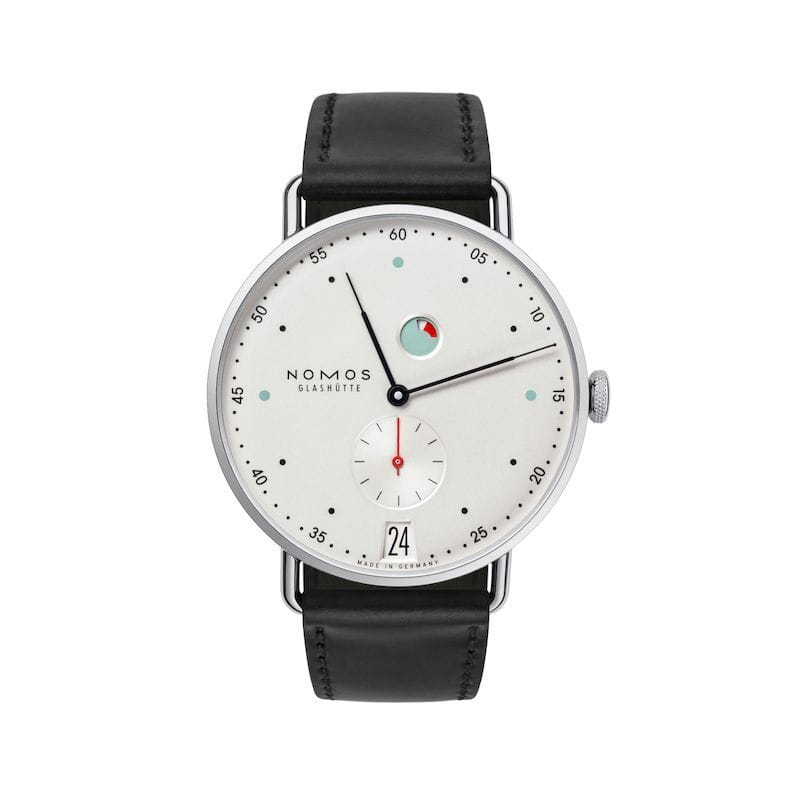
Presented in 2014, the Metro grew out of a project by industrial designer Mark Braun and immediately set itself apart from the rest of the Nomos catalogue through a few unusual stylistic choices compared to the almost geometric rigor of the Tangente and the Orion: the winding crown off-center at 2 o'clock instead of 3 o'clock, numerals with a bolder design inspired by 1930s urban typography, a deliberately more "architectural" character that engages in dialogue with Bauhaus aesthetics without simply restating it literally.
The real leap, however, is technical rather than aesthetic: the Metro is the line with which Nomos introduces, for the first time, its own manufacture escapement, the so-called "swing system," the result of years of research carried out together with the Dresden University of Technology to free the company from dependence on outside suppliers not just for the movement's architecture but for its beating heart as well. From this development come the calibers under the DUW brand (Deutsche Uhrenwerke Glashütte), which over time have also gone on to equip other lines in the catalogue, starting with the Tangente Neomatik.
The Metro therefore represents, more than the historic 1992 lines, the moment at which Nomos completed its path toward total production independence: no longer just cases and finishing designed in-house, but also the time-regulating mechanism, the most delicate component of a mechanical movement, developed and produced in-house.
Technical Specifications
Main Executions
The "swing system" escapement born with the Metro was described by Nomos itself as the first mechanical escapement conceived in Germany and produced in series after decades, a detail the brand has used to claim a role of technical, not just aesthetic, innovation within the landscape of independent mechanical watchmaking.