

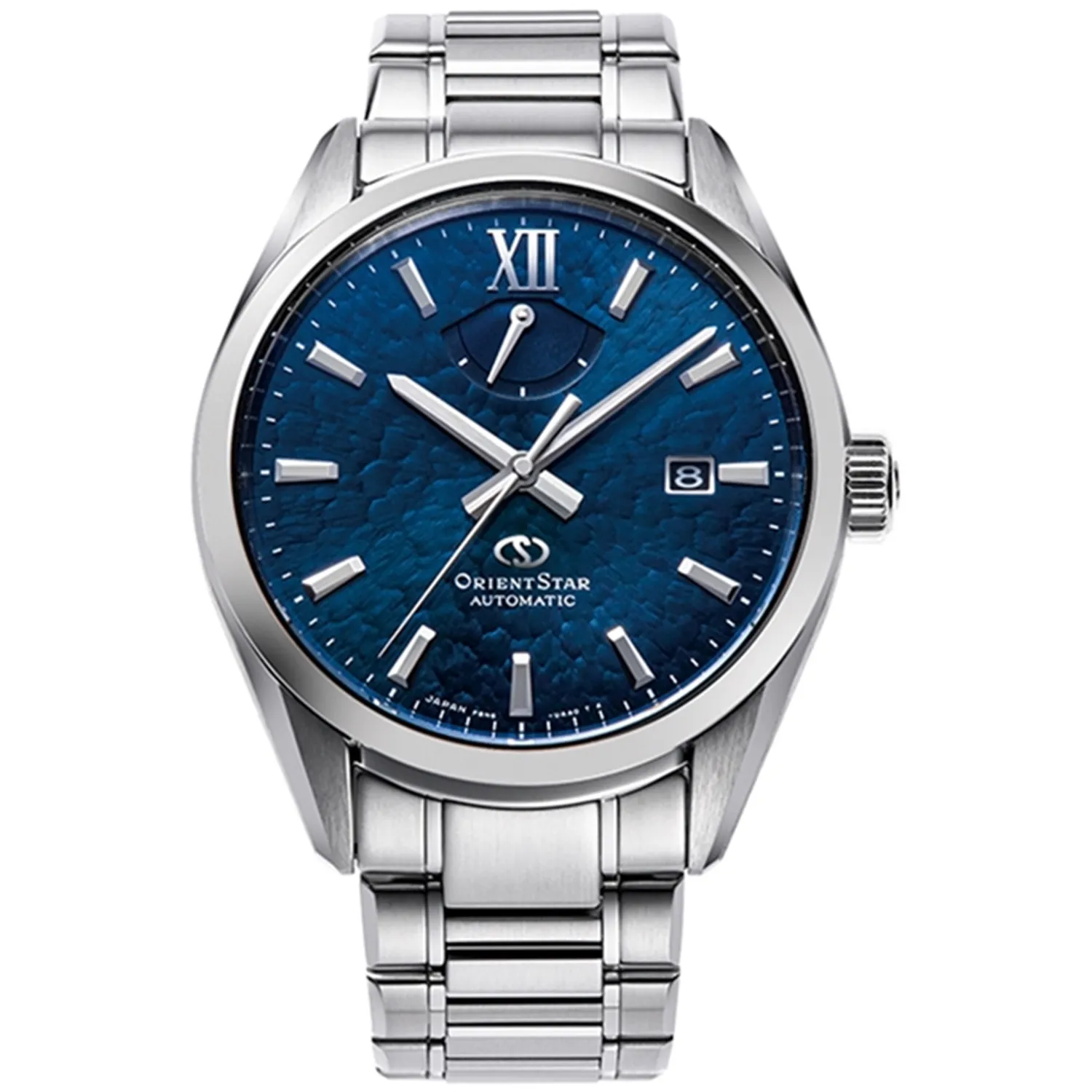
Orient Star
Model History
Orient Star is not a line added to the catalogue at a later point: it is born in the very same 1951 in which Tama Keiki Company changes its name to Orient Watch Company, as a statement of intent from the new company. The very first Orient Star immediately earns chronometer certification, a goal that was far from a given for a brand just refounded from the ashes of Japan's post-war devastation: from day one, in short, Orient Star was conceived not as a mass product, but as the company's most ambitious technical showcase.
The following two decades see the line multiply in several technical directions. In 1955 the Orient Star Dynamic arrives, fitted with the T-type caliber. In 1958-59 the Royal Orient debuts, fitted with the N-type caliber and designed explicitly to challenge the highest tier of domestic Japanese competition, Seiko foremost among them: an episode that illustrates well how the rivalry with Seiko, today softened by their shared membership in the Epson group, was at the time a genuine and direct commercial competition. In 1964 the Orient Star family probably reaches the peak of its technical ambition with the Grand Prix 100, a caliber able to boast 100 synthetic jewels — against the era's standard of 17-21 — conceived more as a statement of manufacturing prestige than as a real technical necessity, but nonetheless indicative of how much the company was investing in those years to demonstrate its capabilities.
In 1967 the slim Finesse line brings the case down to a thickness of just 3.9 mm, while in 1970 the Tenbeat debuts, a high-frequency family designed for above-average rate accuracy. It is a period in which Orient Star absorbs, one after another, almost all the technical fronts then relevant in Japanese mechanical watchmaking: chronometry, case thinness, high frequency, jewel count — an internal catalogue that over time stratifies into different families rather than into a single coherent collection.
With Orient's entry into the Seiko Epson orbit (majority shareholder from 2001, full control from 2009) Orient Star maintains its role at the top of the range, but is reorganized to be more legible for a contemporary audience: today the line is organized into four main families — Classic, with a more formal design closer to the 1950s-60s heritage; Contemporary, designed for versatile everyday use; Sports, oriented toward divers and robust high-end instruments; and Skeleton, the direct heir to the demonstrative spirit of the 1991 Mon Bijou, with open dials that reveal the movement and hand-applied Sallaz finishing.
Orient Star's positioning today is that of a precisely conceived "intermediate step": above Orient's accessible range (Bambino, Mako/Ray) but deliberately below Grand Seiko, the absolute pinnacle of the Seiko Epson group reserved for a much higher price bracket. It is a position of balance that Orient Star has occupied since the 1950s, when its task was already to offer high-level mechanics — power reserve up to 50 hours in the most recent executions, refined finishing, in-house manufacture calibers — without ever reaching the prices of pure high horology, Japanese or Swiss alike.
Technical Specifications
Main Executions
The 1964 Grand Prix 100 caliber is fitted with 100 synthetic jewels at a time when the vast majority of automatic movements, even high-end ones, stopped at between 17 and 21: a number so oversized relative to real mechanical necessity that it has been described more as a manifesto of Japanese technical pride at the height of the postwar economic boom than as real functional progress.