

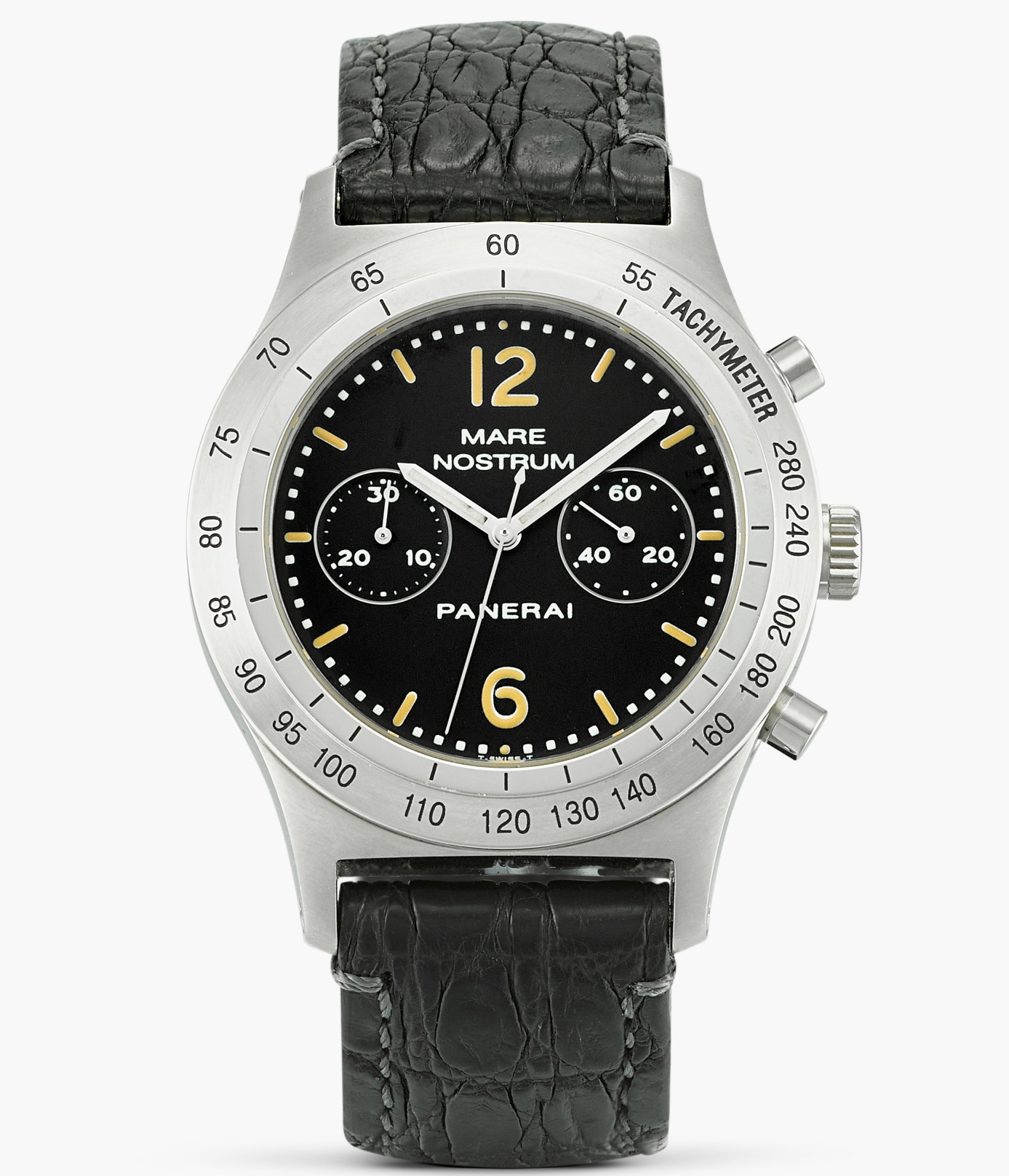
Mare Nostrum
Model History
The Mare Nostrum was born in 1943 as a chronograph prototype designed for deck officers of the Italian Royal Navy, meant for needs different from those of underwater raiders: a massive 52 mm steel cushion case, the Angelus column-wheel caliber 215, a dial in a distinctive seaweed-green shade, and brass hands treated with the brand's patented Radiomir coating. These examples, however, never entered series production and for decades were believed to have been destroyed or lost, until in 2005 Panerai managed to acquire one of the surviving original prototypes at a Christie's auction in Geneva.
The name and design resurfaced as early as 1993, when, as part of the brand's first civilian collection, a reissue of the Mare Nostrum (reference 5218-301) was presented: a more compact 42 mm steel case, blue dial, ETA 2801 base movement paired with a Dubois-Depraz chronograph module, produced in a limited run of about 500 pieces. It is one of three models, together with the Luminor and Luminor Marina, with which Panerai first presented itself to the civilian public.
In the following decades the Mare Nostrum returned several times, always in limited runs: a titanium version at 52 mm in 2004, more faithful to the proportions of the original 1943 prototype, and reference PAM00716 of 2017, a 42 mm case intended for current production. Unlike the catalogue's diving lines, the Mare Nostrum remains the family most tied to the chronograph function and to the bridge officer rather than to the diver, and because of its rarity the brand treats it as one of the most prestigious expressions of its historical archive.
Technical Specifications
Main Executions
The seaweed-green dial of the 1943 prototype is probably one of the most unusual details Panerai ever produced: a coloring far removed from the dark, neutral tones typical of military instruments of the era, which makes the Mare Nostrum prototype one of the most studied and sought-after pieces among collectors specializing in the brand's historical archive.