

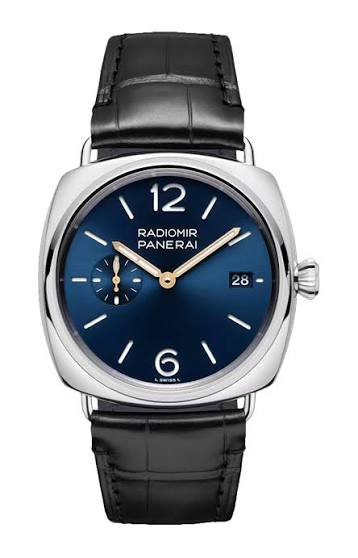
Model History
The name Radiomir was born in 1916 as a patent for a radium-based luminescent powder, developed by the Panerai family together with Lieutenant Colonel Carlo Ronconi to make the Italian Royal Navy's dials and aiming instruments readable even in total darkness, on the seabed or on submerged bridges. Only decades later, with the brand's civilian relaunch, was that name also assigned to a specific line of watches: one that takes up, in the shape of its case, the very first wrist references made by Panerai — without the device that would instead characterize the subsequent Luminor family.
The historical starting reference is the celebrated 3646, developed from the late 1930s in collaboration with Rolex — at the time Panerai's dealer in Florence and supplier of cases and movements, not yet produced in-house by the Tuscan company. A 47 mm steel cushion case, wire lugs welded directly onto the pulley, a "sandwich" dial with a double layer to amplify luminosity: a watch designed for the Navy's divers and, from the Second World War onward, for the raiders of the "Gamma" group of the Decima Flottiglia MAS, remaining in service almost unchanged for several decades with a virtually nonexistent commercial profile.
It was only in 1998, in the midst of the civilian revival begun in 1993, that Panerai codified the Radiomir as a standalone, permanent collection: a case without the bridge-protected crown — the feature that visually distinguishes this line from the bulkier Luminor — with a slimmer profile and a deliberately vintage aesthetic, often paired with California dials (combining Roman numerals in the upper half and Arabic numerals in the lower) or with sandwich variants faithful to the original. Over time the range has expanded from the more compact 40 mm Radiomir Quaranta up to 45 and 48 mm executions, always retaining its role as the more "archival" and less flashy alternative to the rest of the catalogue.
Technical Specifications
Main Executions
The Radiomir name remains tied to a substance — the radium-based luminescent powder patented in 1916 — that today, for obvious radiation-safety reasons, is no longer used on any Panerai watch: since the 1950s hands and indices have been treated with non-radioactive luminescent materials, but the historic name has been kept for its identity and storytelling value.