

Aquanaut
Model History
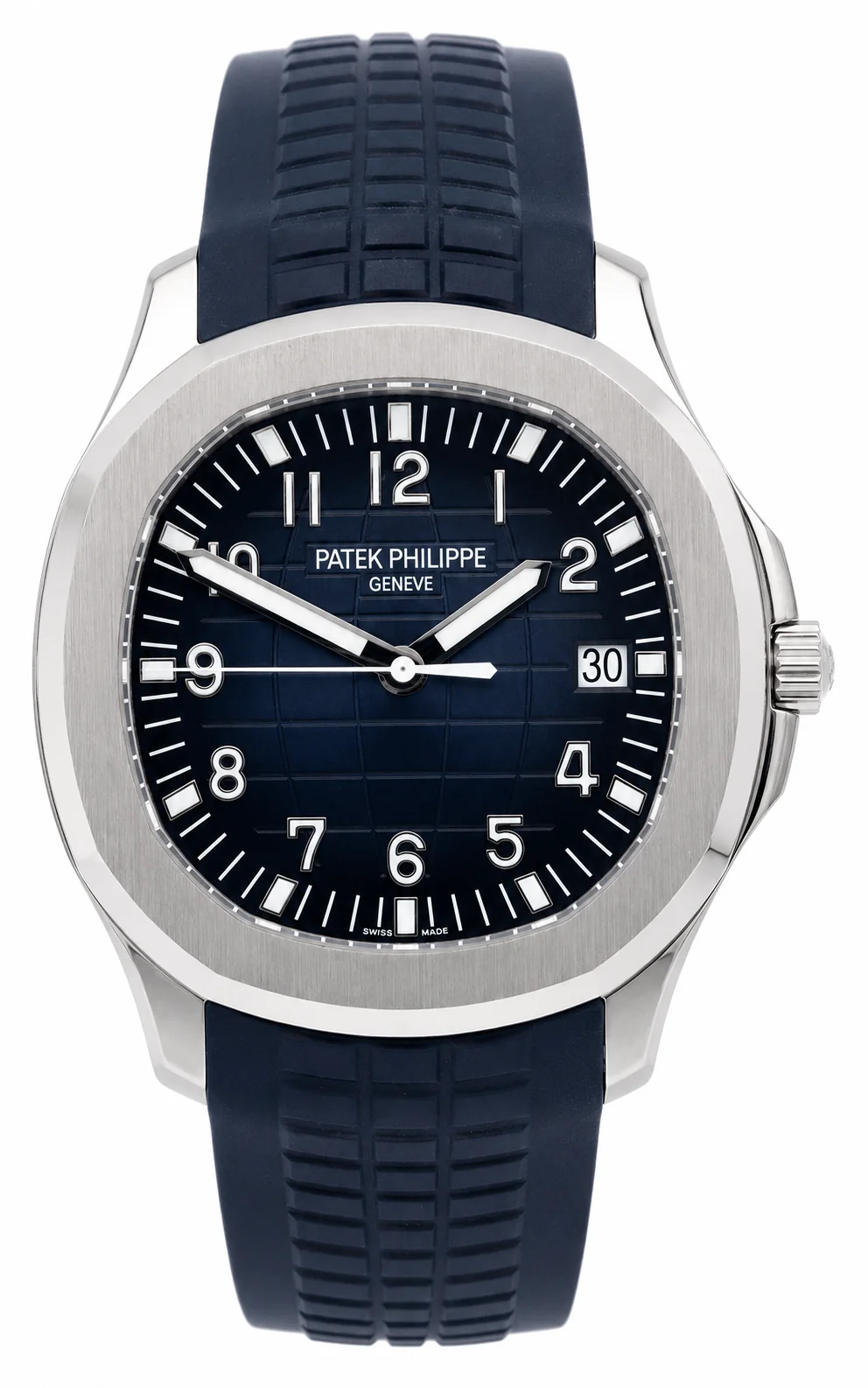
The Aquanaut arrived in 1997, twenty years after the Nautilus, with a declared goal: to speak to a younger, more casual clientele, raised amid the sudden wealth of the internet-company boom, without however straying too far from the sporty luxury language the brand had already codified with Genta. The first reference, the 5060A, offered a 35.6 mm "cushion-shaped" case with rounded corners — a softer, less geometric shape than the Nautilus's octagon — powered by the automatic caliber 330 SC and capable of a water resistance of up to 120 meters, well beyond what is required of a simply elegant watch.
The most innovative element of the Aquanaut, however, is not the case but the strap: in place of the Nautilus's integrated metal bracelet, Patek Philippe introduced an unprecedented composite rubber strap, nicknamed "Tropical", resistant to salt water and UV rays, with a small checkered texture echoing the guilloché motifs of the dial. A material until then foreign to the vocabulary of high watchmaking, which did much to make the Aquanaut perceived as a more informal, "everyday" watch, while keeping the case and movement at the same quality level as any other collection from the brand. The clasp is a folding steel buckle bearing the Calatrava cross emblem, a detail that explicitly ties it back to belonging to the Patek Philippe catalogue.
In 1998 came the ref. 5065A, a "jumbo" version at 38 mm with a transparent sapphire case back; in the following years the line was enriched with complications — the Travel Time with a dual time zone (5164A), the chronograph (5968A) — and with a more feminine, jewelry-oriented declination, the Aquanaut Luce, launched in 2011 with a diamond-set bezel. In 2017 the brand's in-house "Advanced Research" laboratory chose precisely the Aquanaut Travel Time (ref. 5650G) to introduce a white gold case with an integrated strap made from a single piece of molded composite rubber, together with a Spiromax silicon balance spring and a ball bearing for the oscillating weight: a technical testbed for materials and solutions the brand then evaluates for its entire production.
Technical Specifications
Main References
The "Tropical" composite rubber strap, today an identity-defining element of the Aquanaut, was at the time a contrarian choice for Patek Philippe: a material associated with mass-market sports watches, never before used by the brand, which its in-house laboratory had to develop from scratch to guarantee it the same durability and the same color resistance required of a watch meant to last through generations.