

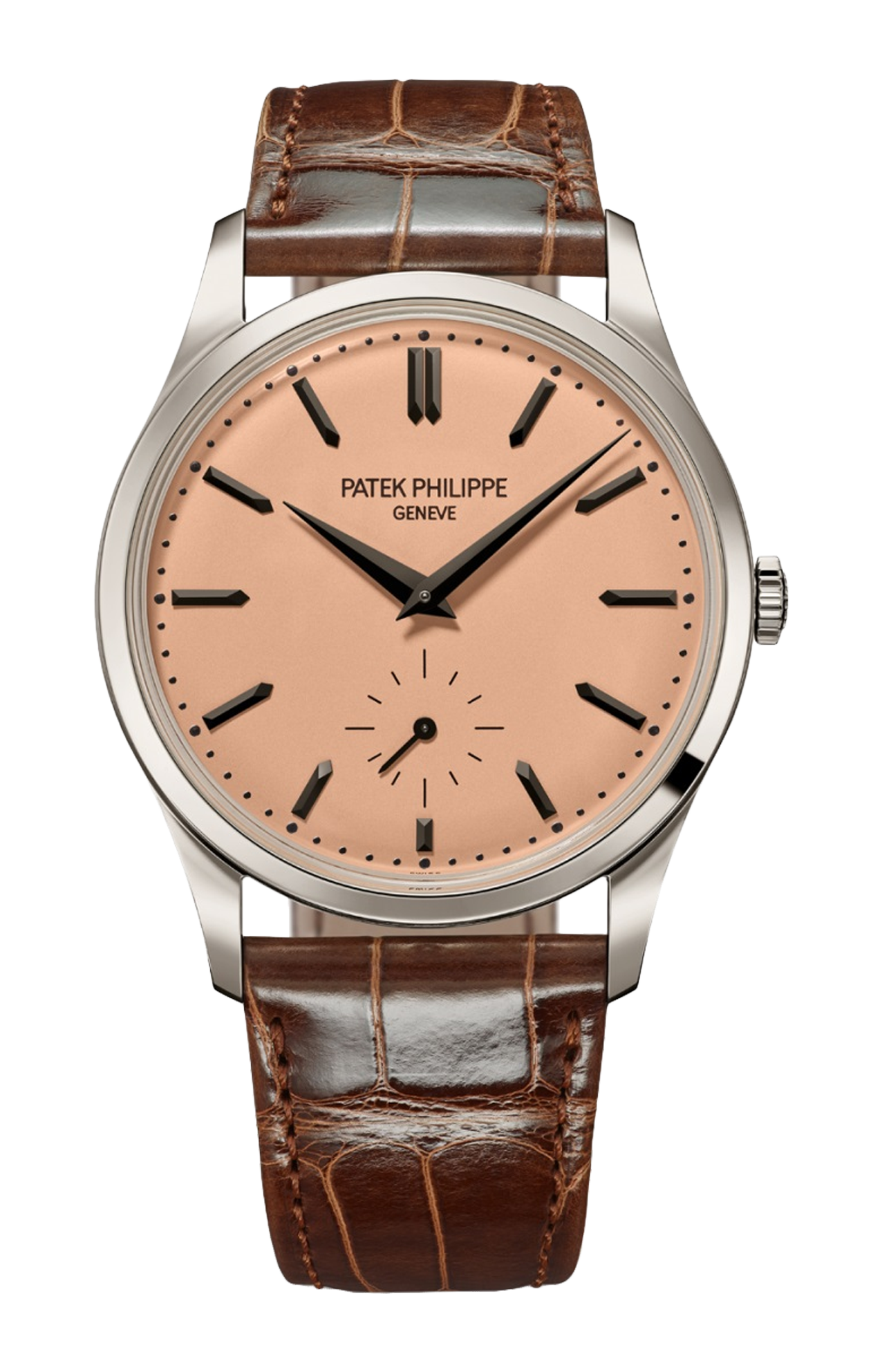
Calatrava
Model History
The Calatrava was born in 1932, the very year in which brothers Charles and Jean Stern took control of Patek Philippe: reference 96, presented in those very months, became the first true stylistic manifesto of the new ownership. In the full Bauhaus era, the watch broke with the decorative richness that had dominated watchmaking until then and instead offered a round case of just 31 mm, flat sides, tapered lugs welded to the case body, and a dial conceived with a single declared goal: to show the time, and only the time, as clearly as possible. Watchmaker Jean Pfister worked on the project's technical direction and on the manual caliber 12'''120 that powered it (introduced in 1934), while the overall design is generally traced to the influence of the Bauhaus style then widespread across Europe.
The line's name recalls the cross of the Knights of Calatrava, a Spanish military-religious order from the 12th century: a symbol that Patek Philippe had already registered as its own trademark in 1887, but which appeared regularly on dials and crowns only from the 1960s onward, becoming from then on the company's own logo. Reference 96 remained in production for over forty years, until 1973, generating in the meantime numerous variants — dials with Breguet numerals, sector dials, versions with central seconds and even some rare steel executions, exceptional for an era in which gold was still the norm for a dress watch.
Over the following ninety-plus years the line has evolved following the taste of different eras without ever betraying its original design: from the ref. 570 of 1938, with its famous "officer" lugs inspired by military models, to the ref. 2526 of 1953, the first automatic Calatrava fitted with the 12-600 AT caliber with a Gyromax oscillating weight; from the ref. 3919, launched in 1985 with its "clou de Paris" (or "hobnail") bezel that in the 2000s became the line's most recognizable execution, up to the modern ref. 5196 with manual winding and the ref. 6119, introduced in 2018 as the new figurehead of the contemporary range. The Calatrava remains, among all the brand's collections, the one most explicitly dedicated to the idea of the "pure" watch: no sports case, no integrated bracelet, but the round three-piece case as the chosen territory for Patek Philippe's classic aesthetic.
Technical Specifications
Main Historical References
The Calatrava cross that gives the line its name did not originate as a watchmaking trademark: it is the emblem of the Knights of the Order of Calatrava, founded in Castile in the 12th century to defend the fortress of the same name. Patek Philippe registered it as its own trademark as early as 1887, almost half a century before it appeared on a dial — today it is the official logo of the entire manufacture, not just of this collection.