

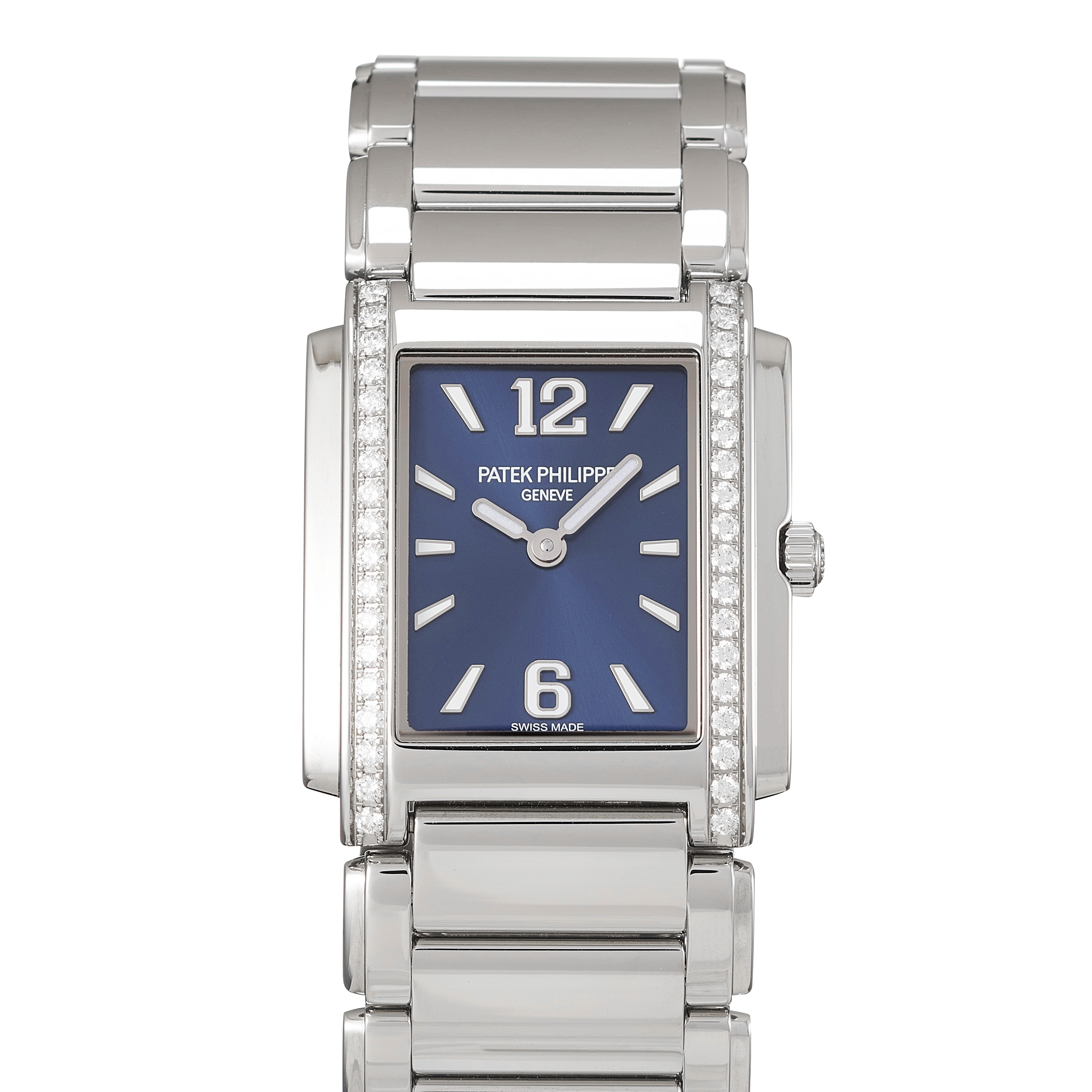
Twenty~4
Model History
The Twenty~4 was born in 1999 with a goal stated by Patek Philippe itself: to offer "a contemporary expression of today's woman", able to wear the same watch from the office to an evening engagement without any break in continuity. The collection's name, written with the distinctive tilde mark between "Twenty" and "4", recalls precisely the twenty-four hours of the day and the versatility the watch must guarantee in each of them. It was the brand's first collection conceived explicitly and solely for a female audience, in a catalogue that until then had adapted for women models originally designed for men, such as some variants of the Calatrava or the Nautilus.
The first generation, opened by the ref. 4910, offered an elongated rectangular case with proportions inspired by Art Deco cuff bracelets — 25.1 by 30 mm, for just 6.8 mm of thickness — powered by a quartz caliber (caliber E15, later E19) and often enriched with brilliant-cut diamonds set along the case's shoulders. The choice of quartz, unusual for a brand that had built its reputation on the most sophisticated mechanics, met a precise need: to guarantee female clientele a watch of maximum precision and minimum maintenance, consistent with intensive, everyday use.
The most significant change in the line's history came in 2018, for the twentieth anniversary: Patek Philippe introduced the ref. 7300, which abandoned the rectangular case in favor of a round 36 mm case, powered for the first time by an automatic manufacture caliber (caliber 324 S C) instead of quartz, while still keeping the integrated bracelet and the aesthetic language that had made the collection recognizable. Since then the two approaches — the historical rectangular one and the more recent round one — have coexisted in the catalogue, both offered in numerous variants of materials, dials and diamond settings, confirming how the Twenty~4 has become, in just over two decades, the brand's benchmark women's collection.
Technical Specifications
Main References
The Twenty~4 remains, together with the Calatrava, one of the very few Patek Philippe collections to have systematically and lastingly adopted a quartz movement: a choice that, for a brand historically identified with the finest mechanical watchmaking, has a precise meaning — putting everyday practicality at the service of the clientele the line addresses, ahead of any display of mechanical complication.