

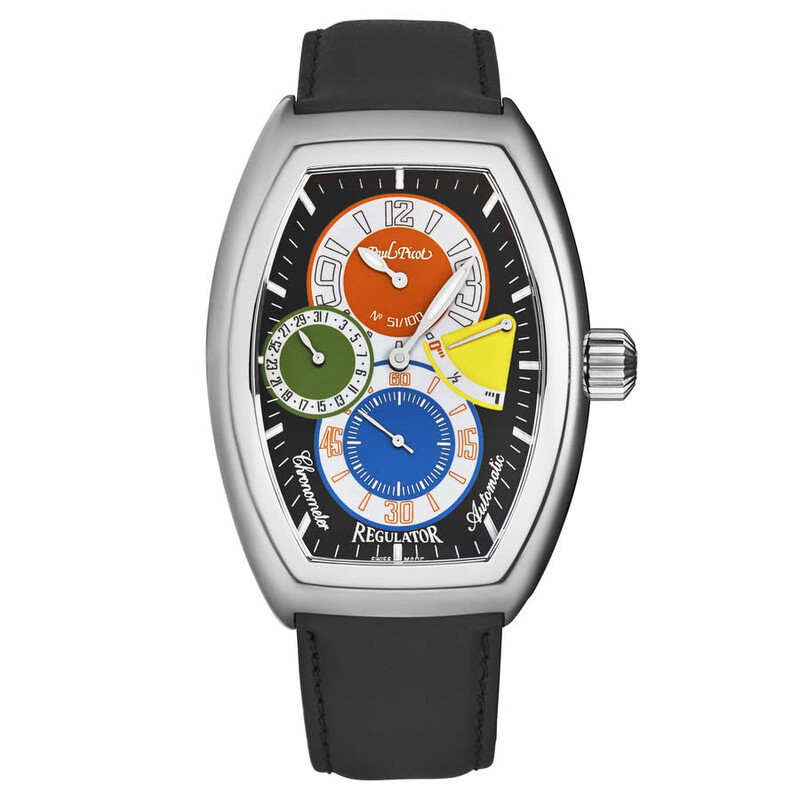
Firshire
Model History
The Firshire is, together with the Gentleman, the most classic and recognizable face of the Paul Picot catalogue: a collection of elegant watches built around two recurring case shapes, the round ("Ronde") and the tonneau, both interpreted with hand-finished dials and a catalogue of complications designed for everyday use rather than technical display. Over the years the line has hosted numerous variants — from the regulator with retrograde seconds to the double moon phases of the "2 Moon"/"Double Moon" version, up to ultra-thin manually wound executions — while maintaining an underlying stylistic consistency that, according to the trade sources consulted, makes it one of the brand's longest-running and most continuous collections.
Several historical Firshire executions carry a numerical reference in their name — such as "Firshire 1937", "Firshire 2000" or "Firshire 3000" — used by the brand to distinguish the different case and movement families born over time around the same line, rather than to indicate an original year of design: a naming convention that makes the Firshire, more than a single reference, a true umbrella of related product families sharing the same aesthetic design.
The line remains active and has been the subject of a recent renewal: in 2026 Paul Picot presented the Firshire Megarotor Classic Sector, an execution that revives the aesthetic of the 1960s — a blue or silver dial with a sunburst finish in "Sector" style, a 42 mm steel case with alternating polished and satin finishes — and pairs it with a tungsten oscillating rotor that the brand describes as capable of cutting winding time by about 20% compared with a conventional rotor, showing how the collection continues to serve as a testbed for small technical refinements within a deliberately classic aesthetic language.
Technical Specifications
Main Executions
The naming of the different Firshire families does not follow a launch-year logic but an internal family code — which is why executions "1937", "2000" and "3000" coexist in the catalogue, even years apart, all actually produced starting from the 2000s: a detail that sometimes confuses less experienced collectors of the brand.