

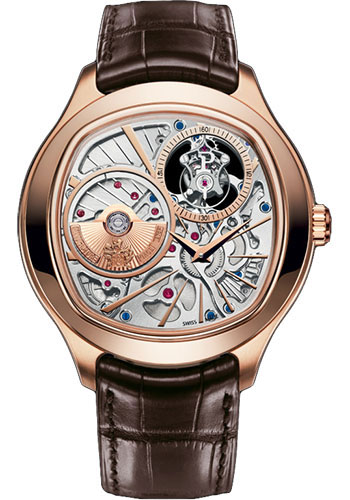
Emperador
Line History
The Emperador name has accompanied Piaget's history since 1957, the year in which the manufacture also presents the celebrated caliber 9P: from the outset the line is conceived as the privileged ground for the brand's most ambitious expressions of fine watchmaking, a vessel for complications and finishes that go beyond the already radical pursuit of thinness in Piaget's calibers. After a period of lower visibility, the collection is relaunched in 1999 with a more defined aesthetic identity, built around a distinctively shaped case: the "cushion" case, or "coussin" in French watchmaking terminology, which becomes the line's immediately recognizable hallmark.
The Emperador case, typically around 46.5 mm, stands out not only for its soft, rounded shape but also for its contained thickness relative to its generous diameter: the line's most celebrated versions, such as the Emperador Coussin Tourbillon, measure just 10.4 mm in depth, a result Piaget claims as the thinnest profile in its category for a watch of these proportions and this level of complication.
The technical heart of the contemporary line is the caliber 1270P, the first ultra-thin automatic tourbillon movement developed by the manufacture: a thickness of just 5.55 mm for a mechanism that integrates both the tourbillon complication and automatic winding, a combination that demands a level of component miniaturization consistent with the tradition of the 9P and 12P calibers, but applied this time to one of mechanical watchmaking's most ambitious complications. The finishing reflects the same level of ambition: gold oscillating weights engraved with the maison's coat of arms, blued screws, satin sunburst decoration and hand-beveled bridges.
Over the years the Emperador line has also hosted other variations on the cushion case, including skeletonized and calendar versions, confirming itself as the reference collection for those who, within the Piaget catalogue, seek the manufacture's highest and most complicated expression, in direct dialogue — despite the case's different shape — with the ultra-thin philosophy that also drives the Altiplano line.
Line Characteristics
Main Executions
The combination of the cushion case, anything but thin in appearance, and an actual thickness of just 10.4 mm is often cited by enthusiasts as a small visual paradox: the Emperador looks like a massive watch, but hides beneath its surface the same philosophy of extreme thinness that Piaget applies, with even more radical results, to the Altiplano line.