

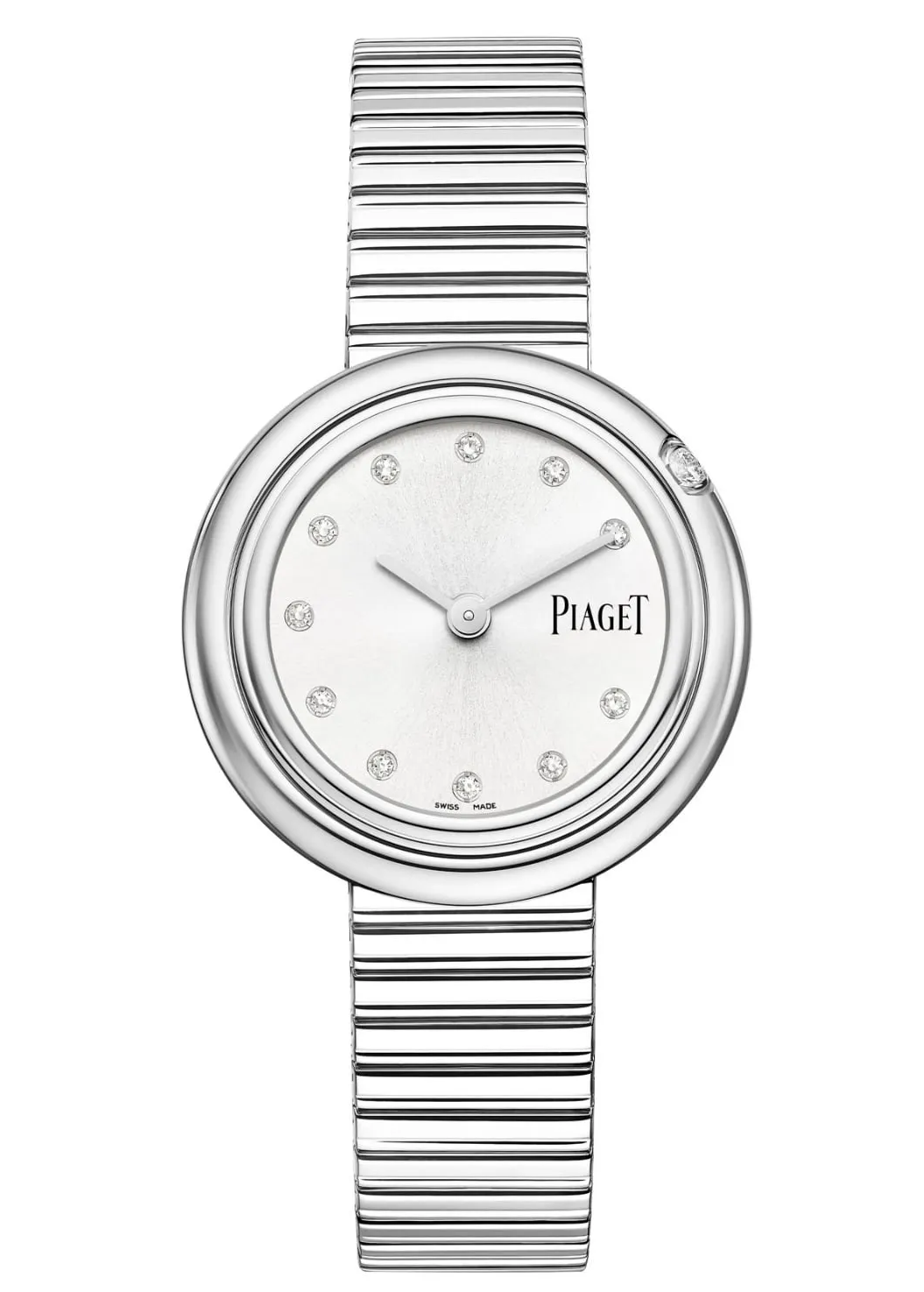
Possession
Line History
The Possession collection was born in 1990 as a piece of jewelry, not a watch: the first model is a yellow gold ring whose central band is not fixed, but free to spin around the wearer's finger. It is an idea as simple as it is effective, turning an almost involuntary gesture — spinning the ring with a finger — into a small, almost meditative personal ritual, able to create a direct emotional bond between the jewel and the person wearing it.
The name itself, Possession, plays on a double meaning: on one hand the literal sense of "possessing" the jewel, on the other the idea of "being possessed" by a repetitive, almost hypnotic gesture. Piaget has always presented the collection not as a simple decorative accessory, but as "a talisman that inspires its owner to take charge of their own life and fulfill their dreams": a narrative that places Possession more in the territory of symbolic meaning than in that of pure aesthetics.
Over more than three decades the collection expands well beyond the original ring, becoming a true family of jewelry — bracelets, earrings and necklaces, all built around the same principle of the movable central element — and, more recently, also a line of watches that revives its aesthetic language, carrying the concept of rotation into the dial or bezel itself. The simplicity of the original gesture, combined with the variety of expressions in yellow gold, rose gold, white gold and diamonds, has allowed Possession to speak to a cross-gender audience, both female and male, while keeping its conceptual identity intact over time.
In 2020 the maison celebrates the collection's thirtieth anniversary, a milestone that confirms its position as one of the brand's most enduring and recognizable jewelry lines, on par — in its ability to withstand passing trends — with historic watch collections such as Altiplano or Polo.
Line Characteristics
Main Executions
Unlike most iconic luxury jewels, Possession's distinctive mark is not visual in the strict sense, but tactile and behavioral: it is the gesture of spinning it, more than its shape, that makes it recognizable to the wearer. An approach that makes the collection a special case in the fine-jewelry landscape, where a piece's identity comes as much from the wearer's interaction with it as from its design.