

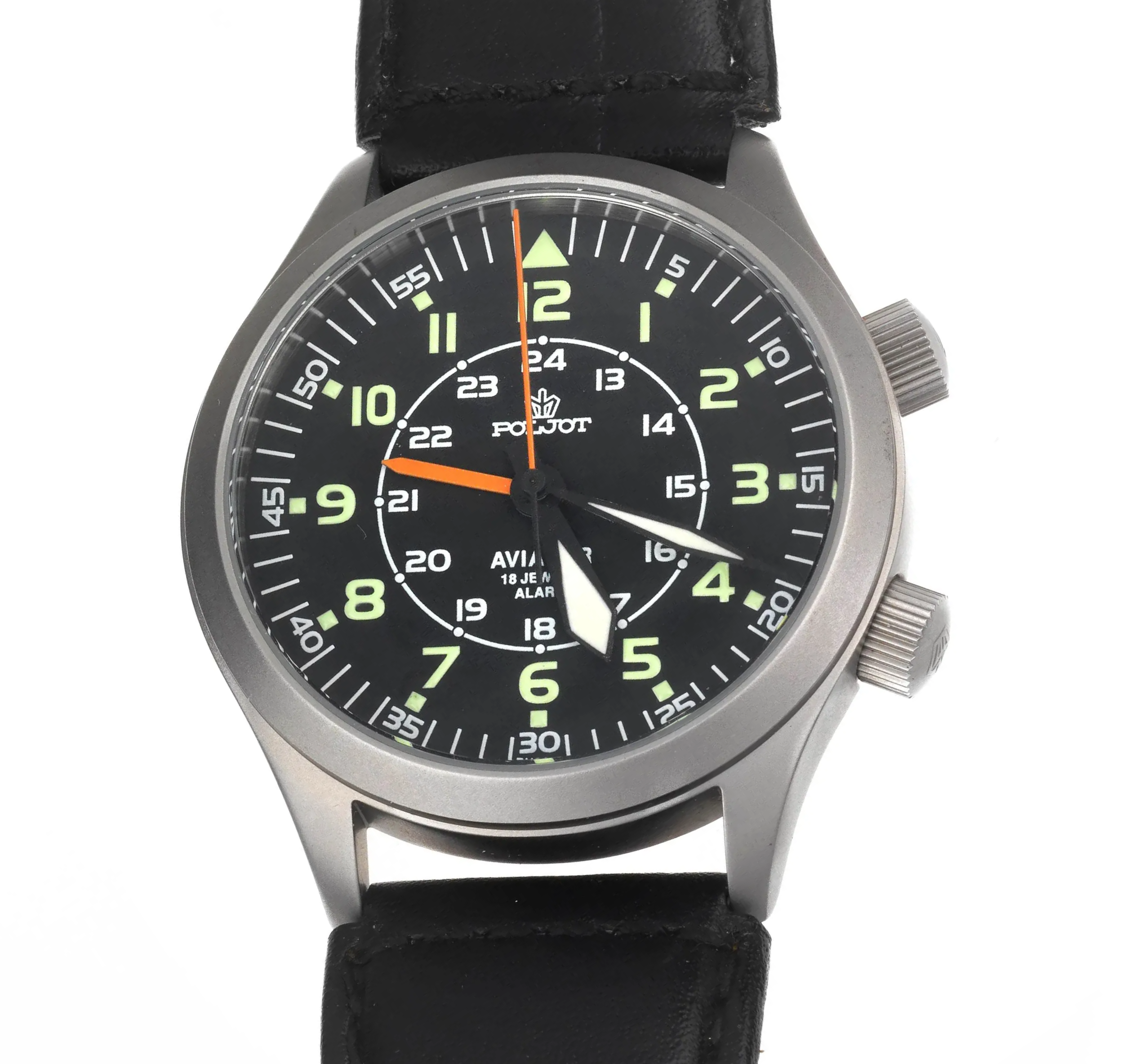
Model History
The Aviator line was built around the 3133 caliber, the manual chronograph that Poljot made widely available starting in 1983 after developing it in the 1970s by adapting components from the Swiss Venus and Valjoux 7734 calibers. With its sturdy steel case, legible black dial with a tachymeter scale on the bezel, and luminescent indices, the Aviator echoed the aesthetic language of the wrist chronographs issued to Soviet military pilots, becoming in the 1980s — together with the Strela — the most recognizable face of Poljot's chronograph production.
It was especially in the 1990s, in the period of openness following the collapse of the Soviet Union, that the Aviator reached its widest distribution: exported in large quantities to Europe and the United States at prices far lower than Swiss mechanical chronographs, it became for many Western collectors their first direct contact with Soviet mechanical watchmaking and with the 3133 caliber in particular, contributing significantly to Poljot's international fame.
With the historic factory's bankruptcy in 2004, the Aviator name too followed the brand's fragmented fate: the rights passed to Volmax, which in subsequent years moved part of production to Switzerland, adopting a design language closer to Western watchmaking standards and, in some respects, further from the original Soviet approach — a further example, alongside Sturmanskie and Buran, of how the Poljot legacy split among different parties and paths after the closure of the parent factory.
Technical Specifications
Main Executions
Thanks to the accessible prices of the 1990s, many Western mechanical-watch enthusiasts discovered the 3133 caliber — and with it the entire Soviet chronograph tradition — through an Aviator model, often bought as their first "real manual chronograph" at an entry cost far lower than Swiss equivalents.