

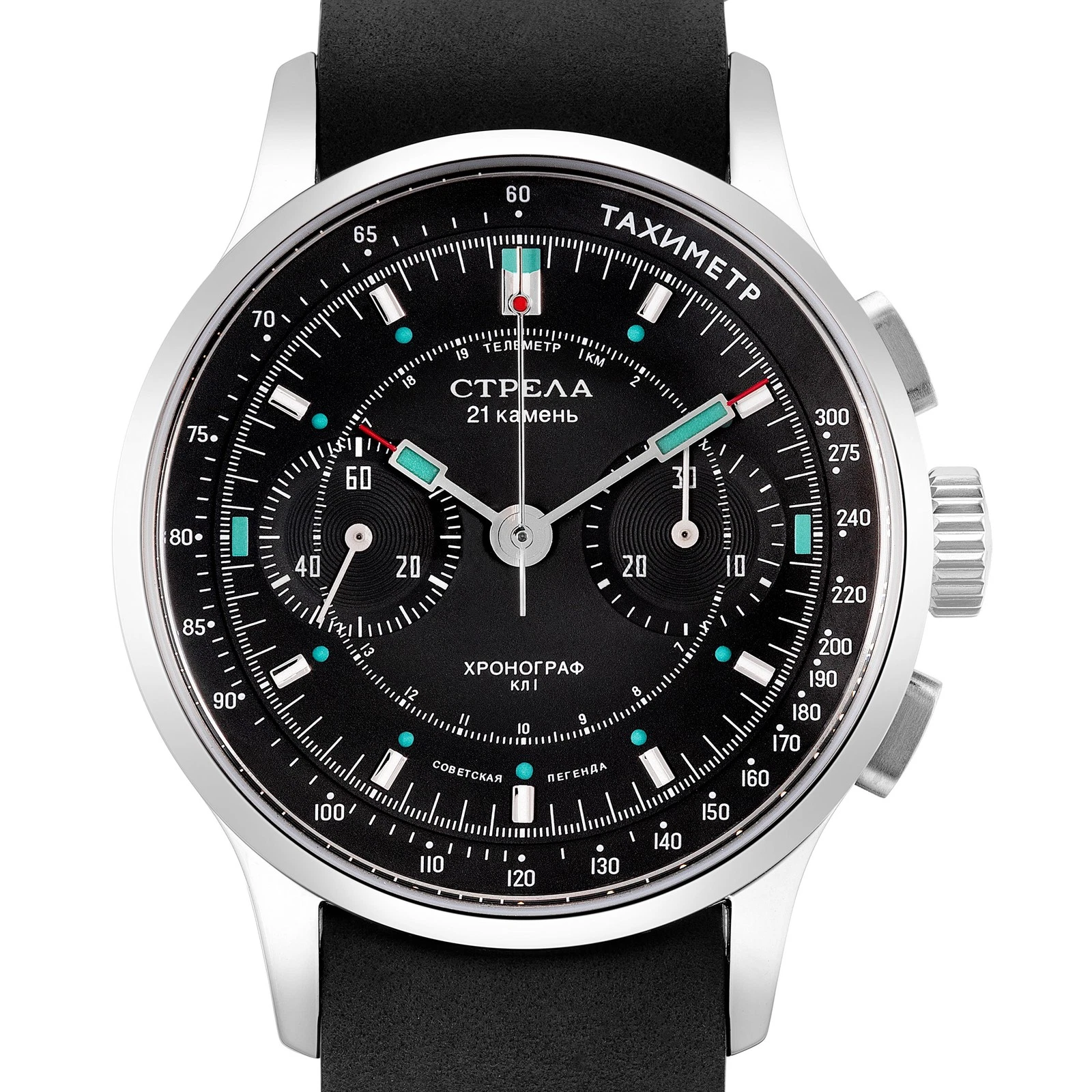
Model History
The Strela — "arrow" in Russian — was born in 1965 as a manual column-wheel chronograph, fitted with the 3017 caliber: a Soviet movement derived from the Swiss Venus 150 and 152 calibers, with 19-21 jewels and 18,000 vph, with two counters laid out on a roughly 45-minute dial. It was a Strela, worn by cosmonaut Alexei Leonov, that accompanied the Voskhod 2 mission on March 18, 1965 and history's first human spacewalk, an episode that alone would be enough to secure the model's place in the legend of Soviet watchmaking.
In the following decades, production of the Strela gradually shifted to the 3133 caliber, the manual chronograph developed by Poljot in the 1970s by adapting elements from the Venus and Valjoux 7734 calibers: a more modern movement, running at 21,600 vph, which became the standard for Soviet military aviation and space program chronographs. The dial design remained consistent with the original layout — sober, legible, with a tachymeter scale on the bezel — keeping a direct visual link to the 1965 example.
After the bankruptcy of the historic Moscow factory in 2004, the Strela brand and part of the 3133 caliber production passed to the MakTime company; over time the business partly relocated to Germany, where ventures such as Strela-Watch continue to offer Russian-inspired chronographs that draw directly on the original model's aesthetic and technical heritage. Today the Strela remains one of the most sought-after names among collectors of Soviet watchmaking, often cited alongside the 3133 caliber as a byword for Poljot's chronograph tradition.
Technical Specifications
Main Executions
The name "Strela" literally means "arrow" in Russian. The watch worn by Alexei Leonov on March 18, 1965 during the Voskhod 2 mission remains one of the most cited pieces in the history of watchmaking linked to space exploration, on a par with Gagarin's Sturmanskie — with the difference that the latter brand later followed a corporate path entirely separate from Poljot.