

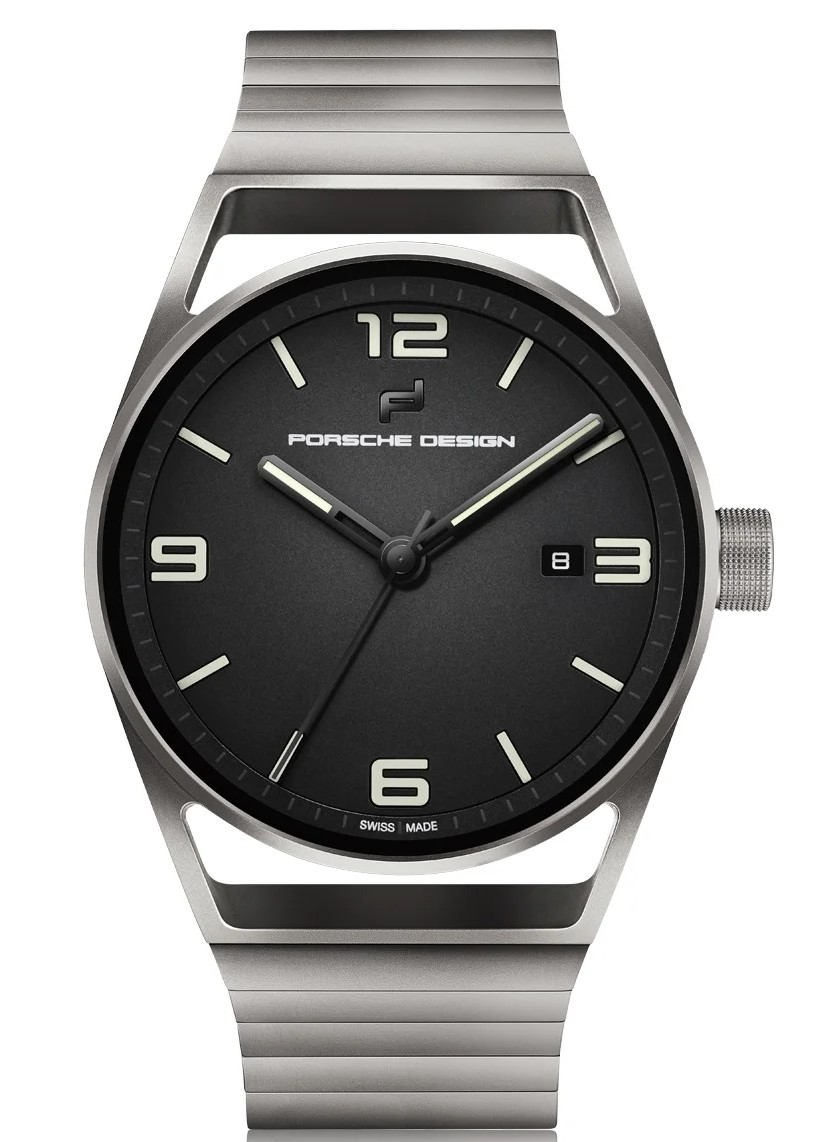
1919
Collection History
Introduced at Baselworld in 2016, the 1919 collection takes its name from the founding year of Ferdinand Porsche's car company — a declared connection to the group's history rather than to watchmaking itself. It is the line in which the brand most directly carries forward Ferdinand Alexander Porsche's Bauhaus language, with proportions and surface finishing that also recall the Porsche 356, the first series-production car signed by the Stuttgart house.
The 1919's distinctive trait is a "skeletonized" lug structure, which connects the case to the strap without traditional welded lugs, reducing the overall visual weight and allowing a glimpse of part of the movement from the side. The titanium case, almost always sandblasted with a contrasting polished crown, bezel and case back, is covered by a domed sapphire crystal with anti-reflective treatment — a combination the brand presents as functional essentiality rather than decoration.
Born as a three-hand collection with a date display (Datetimer), the line has expanded over the years with the Chronotimer Flyback execution, which introduces the chronograph function, and with the Globetimer, fitted with a second time zone — broadening the available complications without departing from the original aesthetic language, assembled since 2014 at the brand's manufacture in Solothurn.
Technical Specifications
Main Executions
The name "1919" has nothing to do with watchmaking in the strict sense: it is the year in which Ferdinand Porsche founded his own design studio in Stuttgart, the remote origin of the entire Porsche group — a way for the watch division to claim a direct link to the car company's roots.