

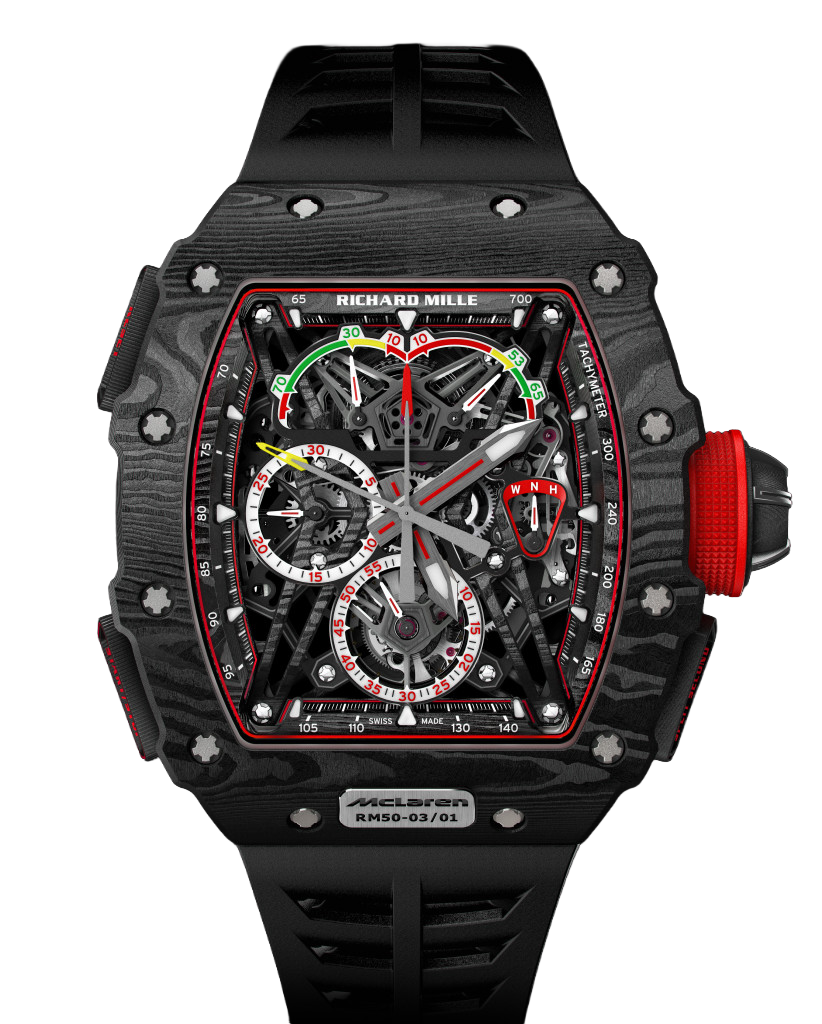
RM 50 McLaren F1
Model History
The RM 50 designation is born in 2014 with the RM 50-01 Tourbillon Romain Grosjean, made for the driver then racing in Formula 1 with the Lotus team. The model extends to the world of Grand Prix racing a technology Richard Mille had already developed for rally and golf: a mechanical acceleration sensor, capable of recording the g-force experienced by the driver's wrist during the hardest braking phases. With over 500 components and just 30 pieces produced, the RM 50-01 immediately sets the tone for the line: a technical testbed built around a specific sporting partner, rather than a simple commercial series.
In 2016 the line expands into an area away from motor racing with the RM 50-02 ACJ, born from the collaboration with Airbus Corporate Jets: the titanium-aluminum alloy case is made from the same material Airbus uses for its own engine turbine blades, able to withstand extreme temperatures and pressures, while the case design recalls the distinctive window shapes of the manufacturer's corporate jets. Here too production remains fixed at 30 pieces, and the model introduces to the brand, for the first time, Torq-set screws and a crown inspired by jet engines.
The line's best-known chapter arrives in 2017 with the RM 50-03 Tourbillon Split-Seconds Chronograph McLaren F1, developed as part of the ten-year partnership between Richard Mille and the McLaren F1 Team (2016-2025): a split-seconds tourbillon chronograph weighing just 38 grams in total — less than half a deck of playing cards — with a movement of only 7 grams, made possible by Graph TPT, a composite combining layers of graphene and resin developed together with the University of Manchester, lighter and 50% stronger than traditional Carbon TPT. The choice of McLaren as a partner is no accident: the British team had introduced the carbon-fiber monocoque to Formula 1 as early as 1981, and Richard Mille has always pointed to that innovation as a direct forerunner of its own materials philosophy. At the end of the partnership in 2025, the RM 50 line remained the brand's main testing ground for its most advanced composites, later carried over into other collections too, such as the McLaren edition of the RM 11-03.
Technical Specifications
The Line's Main Milestones
The Graph TPT used on the RM 50-03 is not an in-house laboratory composite: it was developed in collaboration with the University of Manchester, the very institution where graphene was first isolated in 2004 — a detail that directly links one of the lightest watches ever made to the scientific research that made the material possible.