

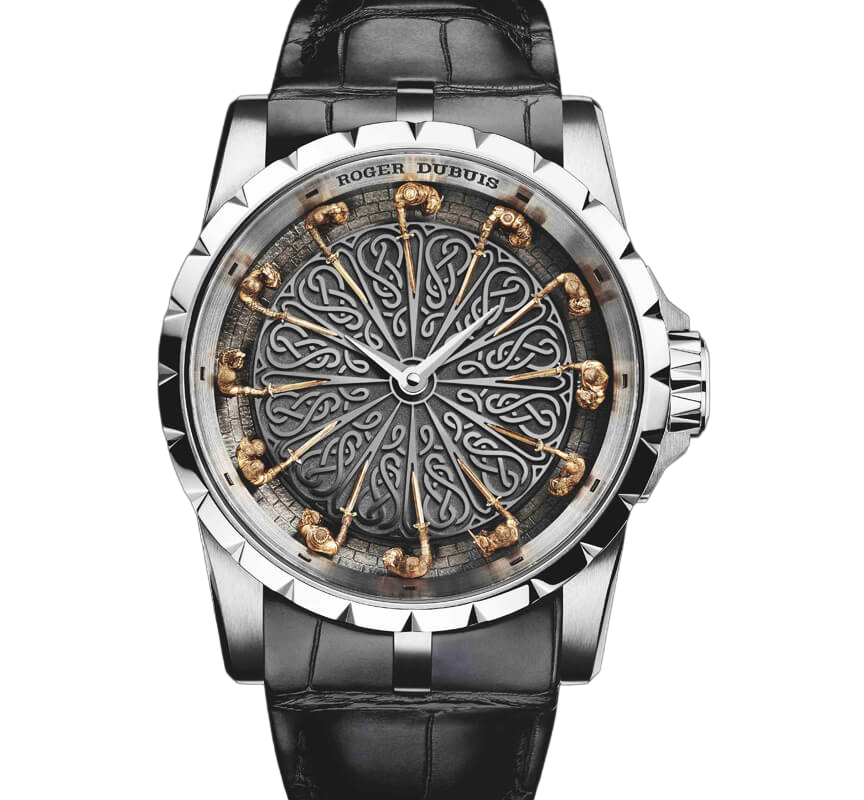
Knights of the Round Table
Model History
First presented at the Geneva show in 2013 with the Knight of the Round Table I (reference RDDBEX0398), the Knights of the Round Table line is born as a natural development of the Arthurian imagery already evoked by the name of the parent collection, Excalibur: if the latter recalls the legendary sword, the new sub-line literally brings the Knights of the Round Table onto the dial. The first model, produced in just 28 units sold initially only at the Geneva boutique, reproduces on the dial's base the design of the painted round table kept at Winchester Castle, with twelve knights hand-carved in gold, each just a few millimeters tall, arranged in a circle around the visible mechanism.
In later editions — the second in 2015, the third in 2017 and subsequent ones up to thematic versions dedicated to specific characters from the legend, such as the wizard Merlin in the "Omniscient Merlin" edition — the brand has evolved both the materials (white gold, rose gold, damascened titanium) and the style of the decoration, moving from more classical depictions to stylized graphic interpretations of the Isle of Avalon, while keeping the conceptual core unchanged: twelve hand-carved knight figures literally watching over the mechanical heart of the watch.
From a technical standpoint the line shares the Excalibur family's construction base, using depending on the edition a monotourbillon or a flying tourbillon placed at the center of the dial and turned into a narrative element: in the Monotourbillon/X edition of 2022, presented at Watches and Wonders as the collection's eighth iteration, the tourbillon is described by the brand itself as a "shield" defended by the twelve knights against the force of gravity, in a multi-layered construction that unites métiers d'art, fine watchmaking and storytelling.
Technical Specifications
Celebrated References
The dial of the first model, from 2013, faithfully reproduces the design of the famous painted round table kept in the Great Hall of Winchester Castle in England, made in 1552 and for centuries associated — without historical basis — with the legendary table of King Arthur.