

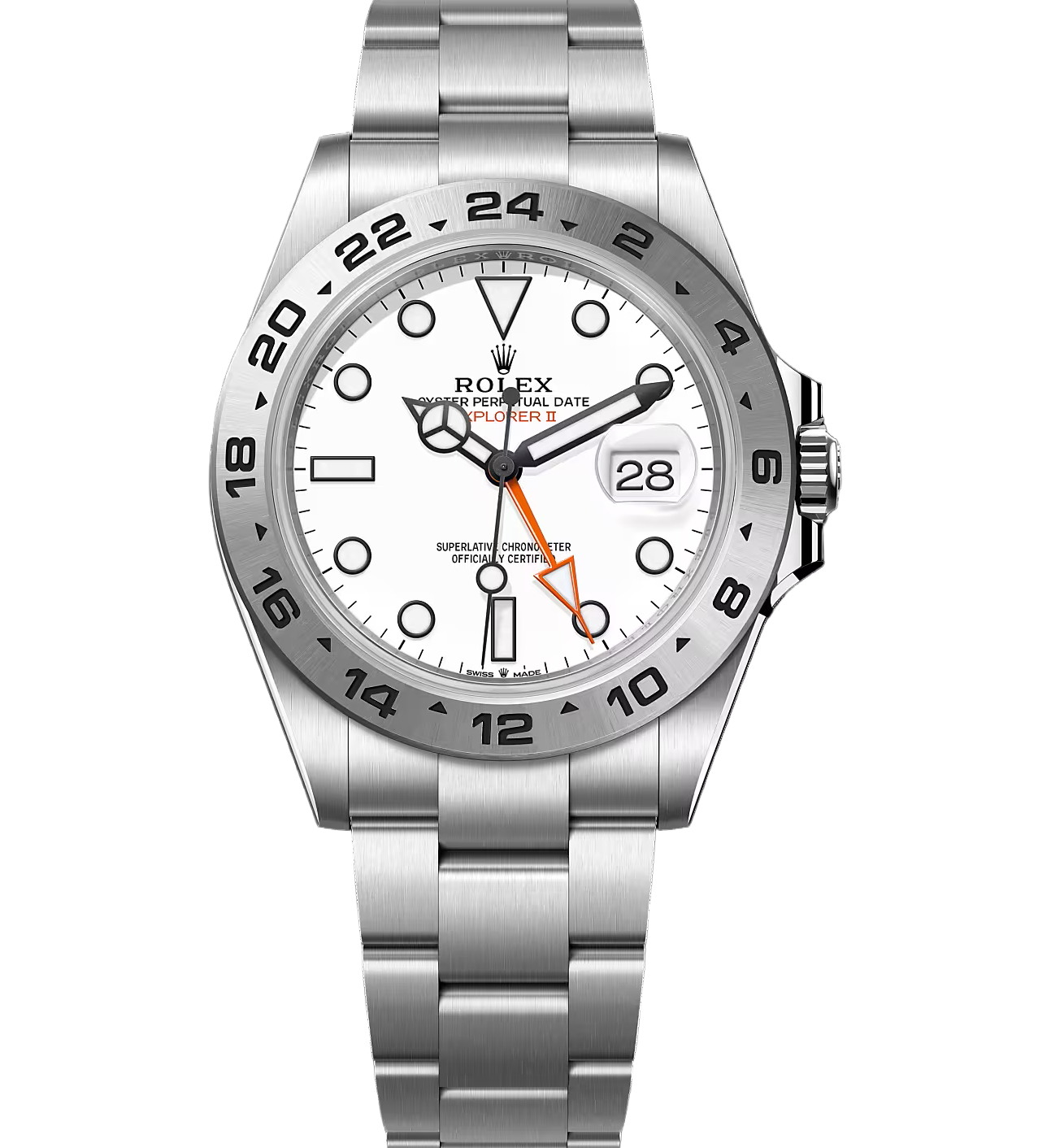
Model History
The Explorer was launched in 1953, the same year as the first successful ascent of Mount Everest by Edmund Hillary and Tenzing Norgay: an achievement that Rolex, already long engaged in testing its watches on Himalayan expeditions since the 1930s with modified Oyster Perpetual models, used as an opportunity to launch a line expressly dedicated to exploration. It should be noted, as various historical sources point out, that it is not fully established that Hillary wore a watch identifiable as an "Explorer" in the sense of the line later marketed, on the summit: the models with references 6150 and 6098, contemporary with the expedition, are considered by experts to be "pre-Explorer" models because of a dial layout not yet fully standardised, while reference 6350 is generally cited as the first true Explorer.
The line's distinctive trait, kept essentially unchanged for over sixty years, is the black dial with Arabic numerals at the 3, 6 and 9 positions — the so-called "3-6-9" layout — paired with a luminous inverted triangle at 12 o'clock and the "Mercedes" hands already seen on the Submariner: a graphic language designed to guarantee maximum legibility in difficult conditions, from the darkness of caves to the intense cold of high altitude.
For decades the Explorer's case kept a 36 mm diameter, a size preserved up to reference 114270; only in 2010, with the introduction of reference 214270, did the diameter rise to 39 mm, before returning, in the most recent generations, to a compromise close to 36-40 mm depending on the version in production. Alongside the original Explorer, Rolex introduced the Explorer II in 1971, reference 1655, a related but distinct line designed for cavers and miners with a fixed bezel graduated over 24 hours and a prominent orange hand, useful for telling day from night in underground environments without natural light.
Technical Specifications
Notable References
Contrary to a widely told story, it is not confirmed that Edmund Hillary wore, on the summit of Everest in 1953, a watch corresponding exactly to the Explorer line later marketed: the references from that period are considered by experts to be "pre-Explorer," and the line as we know it today was launched by Rolex precisely by capitalising on the fame of that expedition.