

Korona
Model History
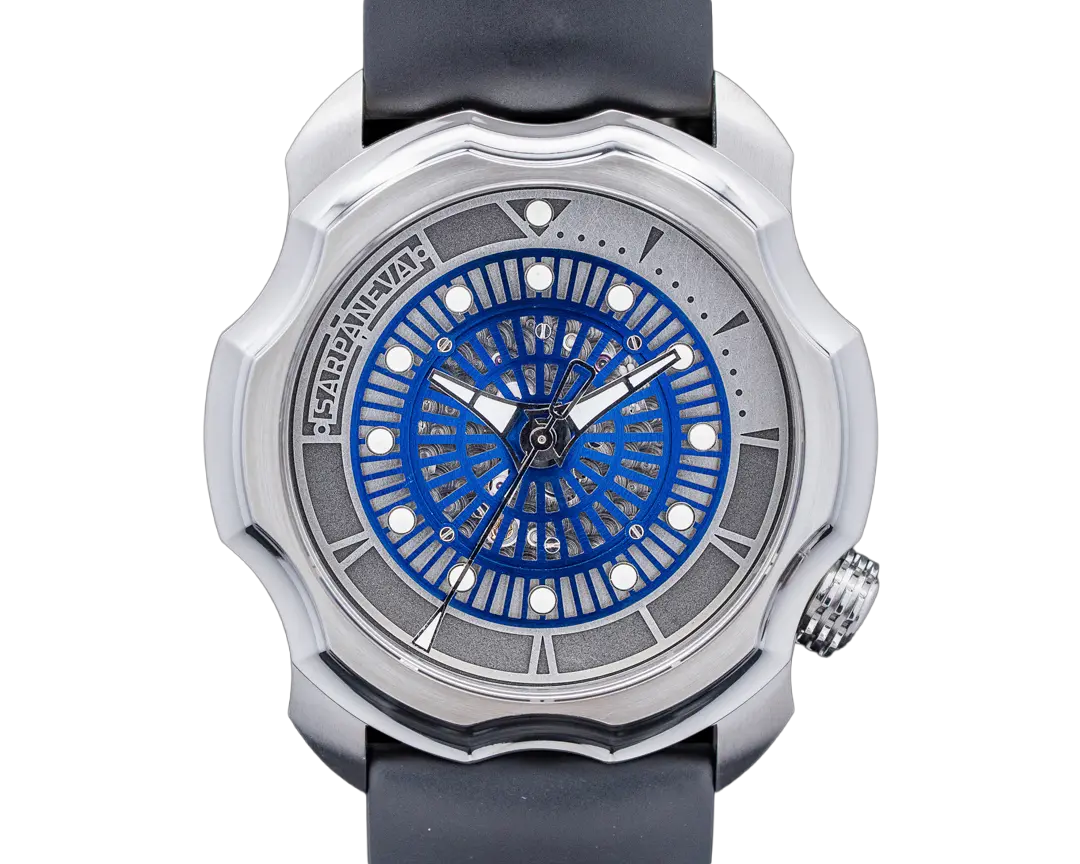
The Korona debuted at Baselworld 2008, when Stepan Sarpaneva presented the first collection made almost entirely for his own brand, after years during which the Helsinki atelier had worked mainly on commissions for Christophe Claret. The name, which in Finnish evokes the idea of a corona or luminous halo around a celestial body, reflects Sarpaneva's stated inspiration in the strong contrasts between light and dark of Nordic nights: a multi-layer case with a scalloped bezel and fluid lugs encloses a dial dominated by a strongly stylized moon face, often modeled on the watchmaker's own features.
The first series of the K1, presented in 2008, measures 44 mm in diameter for just 9.6 mm in thickness. Already from September 2009, the sources consulted document a redesigned second generation at 42 mm (10.2 mm thick), with an added seconds hand, a double-security crown and a larger, clearer date disc: this is the configuration that, with small dial variants, became the line's standard. The movement, in both cases, is a Soprod A10 caliber (an evolution of the ETA 2891-A2) heavily modified by Sarpaneva, with a steel rotor and white gold weights.
In 2009 the Korona K3 Black Moon variant won the Red Dot Design Award and two Good Design Awards from the Chicago Athenaeum: a recognition that cemented the Korona's moon face as the brand's stylistic signature, later reprised with different technical solutions in all of Sarpaneva's subsequent collections. Over the years the line has expanded with numerous special dial and case executions (including titanium, red gold and enamel-finish variants); the exact number of all references produced over more than fifteen years cannot, however, be reliably reconstructed from the public sources consulted, as this is a brand with artisanal and very limited production.
Technical Specifications
Main Executions
The Korona's moon face is often described by Stepan Sarpaneva himself as having its own expression and character: a detail the Finnish watchmaker has repeatedly pointed to as the most personal and distinctive trait of his work, long before it became the brand's recognizable symbol.