

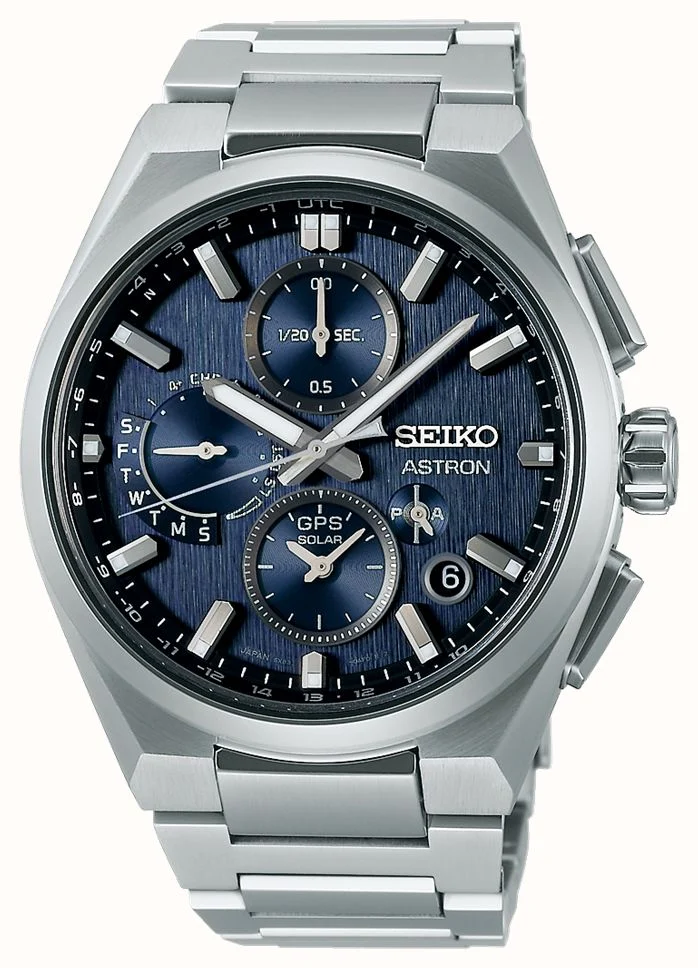
Line History
On December 25, 1969 Seiko presented the Quartz-Astron 35SQ in Tokyo, the first quartz wristwatch in the history of watchmaking: the result of about a decade of research carried out by Suwa Seikosha (the company that would later become Seiko Epson), culminating in a caliber capable of replacing the traditional mechanical escapement with an XY-type quartz oscillator vibrating at 8,192 Hz, a hybrid integrated circuit and a step motor. Seiko declared an accuracy of ±5 seconds per month for the Astron, an enormous leap compared to the best mechanical chronometers of the time, capable at most of a few seconds per day.
The first example, in a gold case, went on sale for 450,000 yen, a figure at the time comparable to the price of a mid-size car: a positioning that underlines how the Astron was born not as an immediate mass-market product, but as a flagship technological demonstration, before paving the way, in the following years, to the widespread, industrial-scale adoption of quartz across all Japanese and global watchmaking.
The Astron's impact on the watch industry is among the most cited in the sector's history: the rapid spread of quartz movements, more accurate and cheaper to mass-produce than traditional mechanics, plunges the Swiss watch industry into deep crisis over the course of the 1970s, a period industry historians have dubbed the "quartz crisis". Seiko itself, according to what the brand has handed down, declared at the time that "one day all watches will be made this way" — a prediction that would prove substantially correct for most of global watch production in the following decades.
The Astron name returns to prominence in 2012, when Seiko assigns it to a new generation of watches: the Astron GPS Solar, capable of receiving satellite signals to automatically set the time and time zone anywhere in the world, powered by solar energy. A second technological "revolution" declared by the brand itself, which in 2019 celebrated fifty years since the 1969 debut with special commemorative editions, explicitly recalling the legacy of the original 35SQ caliber.
Technical Specifications (Quartz-Astron 35SQ, 1969)
Main Line Milestones
The Astron's 35SQ caliber is listed among the IEEE Milestones, the international registry that recognizes engineering innovations of historical significance: a recognition that places a wristwatch alongside inventions of universal scope in the history of electronics, testifying to how much that single December 1969 launch actually changed the rules of an entire industrial sector.