

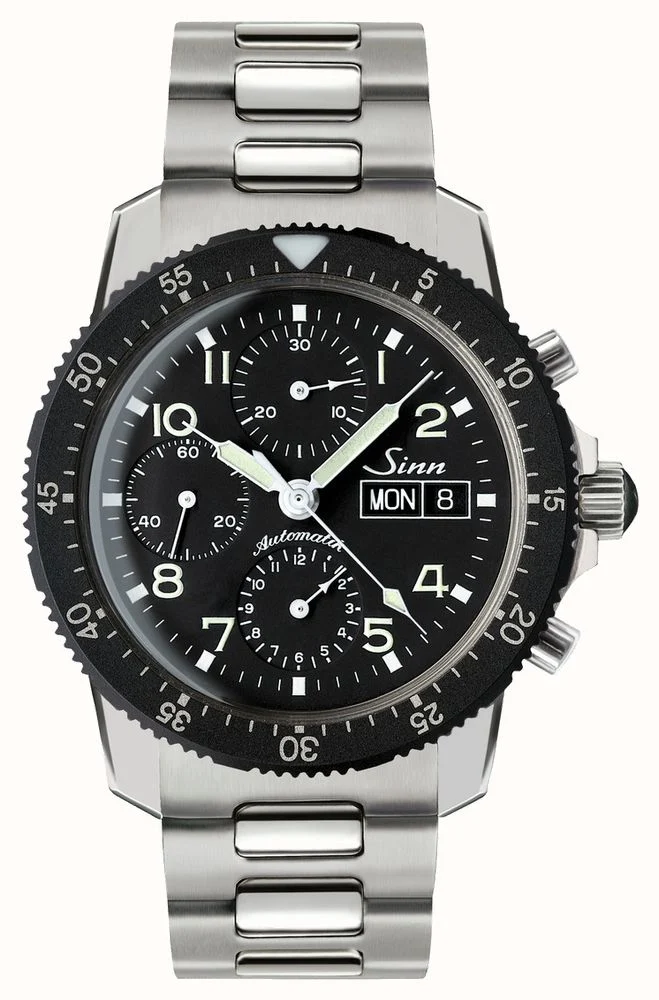
Model History
The 103 was born in the mid-1960s, the same years in which Helmut Sinn — a former Luftwaffe pilot and flight instructor — started his cockpit watch and aviation chronograph business in Frankfurt am Main. The first executions, assembled from around 1966, use cases and components of Swiss origin, including parts traceable to Breitling, Gallet and Excelsior Park, and take up the case design of the Jaeger-LeCoultre Ref. E2643 — known among collectors as the "Shark" or "Shark Deep Sea" — from which Sinn sourced regularly.
In the following decades the model went through the evolution of the column-wheel chronograph calibers Valjoux 72, then Valjoux 726, up to the adoption, in the 1980s, of the Valjoux 7750 (and of the manual-winding variant 7760), which allowed production on a larger scale. In 1998 the titanium version 103 Ti Ar, equipped with the Ar-Dehumidifying technology introduced by Sinn a few years earlier to protect the movement from humidity by keeping it in dry argon, won the German Goldene Unruh award ("golden hand").
Remaining in uninterrupted production to this day, the 103 is offered in numerous variants — from the base 103 St to executions with the Diapal escapement, free of lubricant (since 2010), up to the Klassik with vintage-style counters at 3-6-9 (limited edition of 500 pieces, 2012) — always keeping the rotating pilot's bezel and the instrument-style approach that has characterized the brand since its origins.
Technical Specifications
Main Executions
The case of the 103 takes up the design of the rare Jaeger-LeCoultre Ref. E2643, nicknamed by collectors the "Shark" or "Shark Deep Sea": a detail that shows how, in its early years of activity, Sinn assembled its watches from components by high-level Swiss manufactures, before progressively developing in-house technologies and production.