

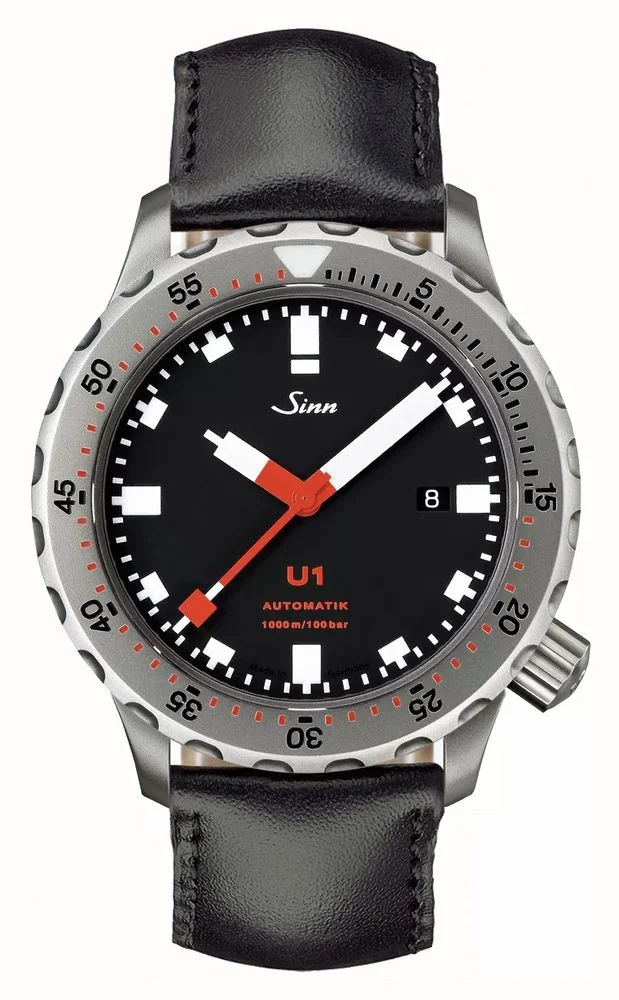
Model History
Presented at the Basel fair in 2005, the U1 was born from Sinn's need to create a professional diving watch capable of permanently resisting the corrosive action of sea water, a requirement that ordinary 316L steel, however widespread in diving watchmaking, cannot guarantee in the long term. The solution identified by the Frankfurt technicians was to turn directly to a supplier of steel for military naval use: the material of the U1's case comes from the same supply chain that provides the steel for the hulls of the German Navy's submarines (Class 212, built by ThyssenKrupp Marine Systems), chosen for its exceptional resistance to salt corrosion and for its non-magnetic properties.
This "submarine steel" also proved to be an excellent base for the Tegiment treatment developed by Sinn: when subjected to surface hardening, it can reach a hardness of about 1,500 Vickers, about 300 Vickers higher than what can be obtained with the steel used in other Tegimented cases by the brand. The diving bezel, unidirectional and fitted with a "captive" ball-bearing fixing system rather than a simple snap, is designed to withstand accidental impacts without shifting.
With a stated water resistance of 1,000 meters (100 bar), certified by an independent institute according to European standards for diving watches (EN 250, DIN 8306 and DIN 8310), the U1 established itself as one of the most identifying models of the Sinn catalog, to the point of giving its name to an entire family of derivatives — including the higher-performing U2, capable of reaching 2,000 meters.
Technical Specifications
Main Executions
The steel used for the U1's case is not a generic material inspired by the naval environment, but comes from the same supply used by ThyssenKrupp Marine Systems for the hulls of the German Navy's submarines: a detail that Sinn explicitly cites as proof of the material's resistance to sea water under conditions of permanent use.