

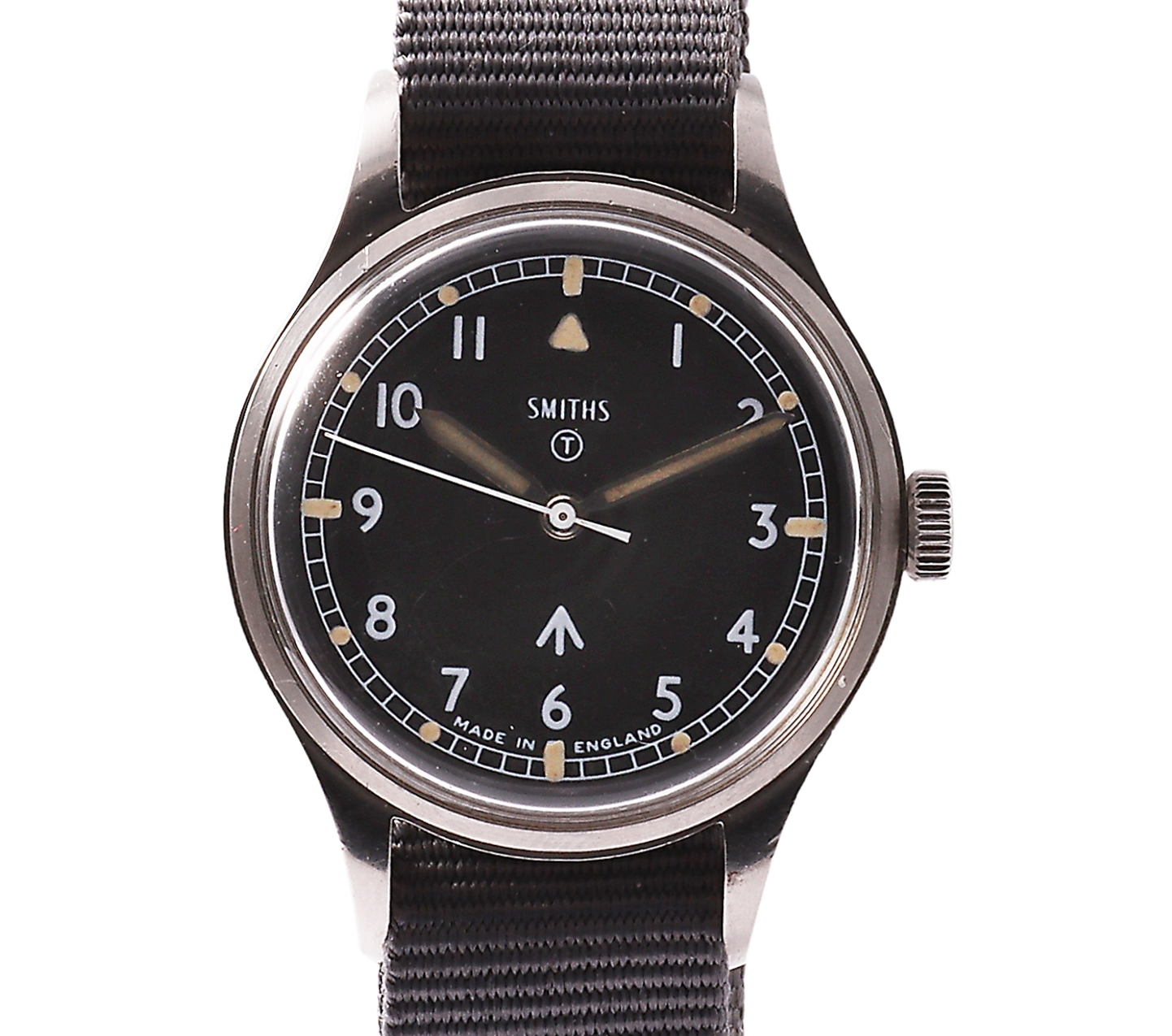
Military (PRS-29)
Line History
In 1966 Smiths wins a contract from the British Ministry of Defence to supply a new field watch for the armed forces: thus, between 1967 and 1970, the W10 is born, a 35 mm steel case with a 17-jewel caliber 60466E movement featuring a hacking function (seconds stop for synchronization), a highly legible dial with tritium hands and the "broad arrow" that for centuries has identified government property in Britain. The different services received cases marked differently on the case back: "W10" for the Army, "6B" for the Royal Air Force, "0552" for the Royal Navy.
The W10 went down in history as the last British-made mechanical watch issued to the armed forces of the United Kingdom: already in the early 1970s, for cost-containment reasons, the contract for supplying field watches passes from the British Smiths to the American Hamilton. A few years later, helped by the quartz crisis, Smiths abandons watch production altogether, by the end of the decade.
When Timefactors relaunches the Smiths brand, the W10 is among the first historic models to be revived: thus the Military line is born, marketed under the code PRS-29, described by Timefactors itself as an "almost identical" reconstruction of the original. The diameter rises slightly from 35 to 36 mm to suit contemporary wrists, but the approach remains that of an essential field watch, with a hand-wound movement, a high-contrast dial and the broad arrow on the dial recalling the model's military origin.
Technical Specifications
Main Executions
The "broad arrow" that appears on the PRS-29 dial is not a watchmaking invention: it is a British state-ownership mark that dates back centuries before wristwatches, historically used to mark equipment and materials belonging to the Crown, from uniforms to military issue.