

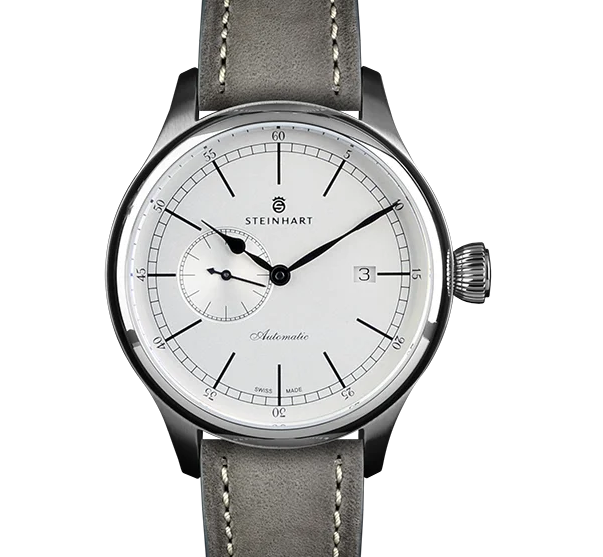
Marine Chronometer
Model History
The Marine Chronometer line is inspired by marine chronometers, the high-precision instruments mounted on gimbals inside wooden boxes that, starting with the studies of the English carpenter John Harrison in the 18th century, allowed ships to calculate longitude on the open sea by comparing local time with that of a reference meridian. According to the brand itself, these instruments were also made for a long time for the German navy in centers such as Hamburg, Kiel and Glashütte, remaining in use on board until the spread of quartz movements.
Steinhart takes up this legacy and transfers it to the wrist: the line stands apart from the brand's diver and pilot collections through a more formal setup, with dials that often display classic-style Roman or Arabic numerals and brushed steel cases. In some executions, such as the Marine Chronometer 42 with the ETA/Unitas 6498 movement, the caliber is derived directly from pocket watches, manually wound, and partly visible through the sapphire crystal: according to the brand's official website, this version is available only in limited quantities.
In the brand's communications, the historical reference also extends to the onboard chronometers used by deck officers during the Second World War to calculate position at sea. However, the sources consulted do not specify a precise launch year for the line's introduction into the Steinhart catalog, nor an exhaustive list of all the executions produced over time: we note this explicitly, as it was not possible to verify it with certainty.
Technical Specifications
Main Executions
Fitting a caliber born as a pocket-watch movement — the ETA/Unitas 6498 — into a wristwatch, letting its architecture show through the sapphire crystal, is how Steinhart makes explicit the direct link between this collection and the onboard instruments it is named after.