

History of the line
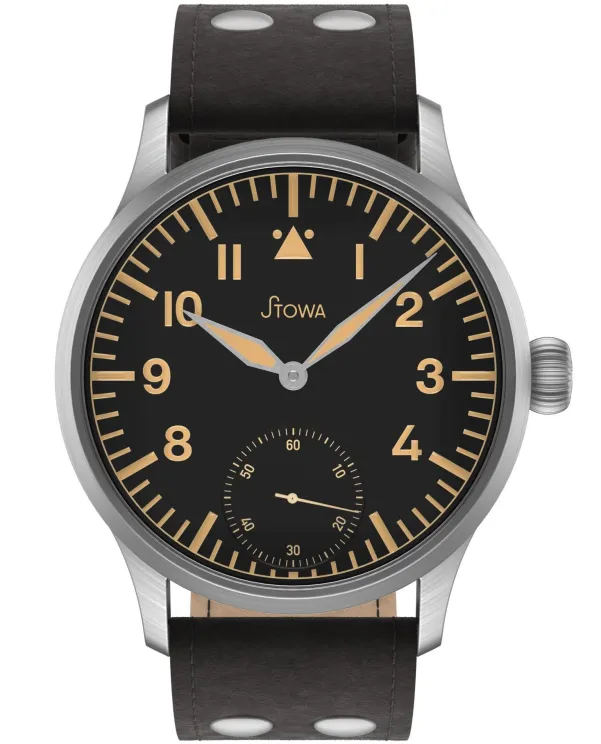
The Flieger was born as a military instrument: from 1939 Stowa was one of only five companies authorised to build Beobachtungsuhren ("observation watches") for the Luftwaffe, together with A. Lange & Söhne, Laco, Wempe and IWC. Sources agree in placing the start of production of the large pilot's watches (the so-called B-Uhren, 55 mm in diameter, designed to be read even with flying gloves) between 1939 and 1940, with the "Baumuster A" — a dial showing only the hours in Arabic numerals — as the first version, followed shortly afterwards by the "Baumuster B", recognisable by its outer minutes ring and smaller inner hours ring.
Original production stopped with the destruction of the Pforzheim factory in the bombing of February 1945. The design nonetheless remains a historic reference for German pilot's watchmaking, handed down through pieces preserved in museums and on the collectors' market.
The modern relaunch came under Jörg Schauer, who took over Stowa in 1996: according to several industry sources, the Baumuster A reissue arrived in 1997, for the brand's 70th anniversary, followed by the Baumuster B in 2010 and a chronograph version in 2012 (the sources found for these specific years are secondary and not all in agreement, so they should be considered indicative). Today the line includes several families — including the Flieger Original, Flieger Classic and Flieger Vintage — with smaller diameters than the original 55 mm (generally 36-41 mm) and, since 2016, voluntary compliance with the German DIN 8330 standard for pilot's watches.
Technical specifications
Main versions
On the Classic versions, Stowa engraves on the caseback or case the historic code "Fl 23883": a direct reference to the technical nomenclature the Luftwaffe used to catalogue flight instruments, kept as a detail of continuity with the original military watch.