

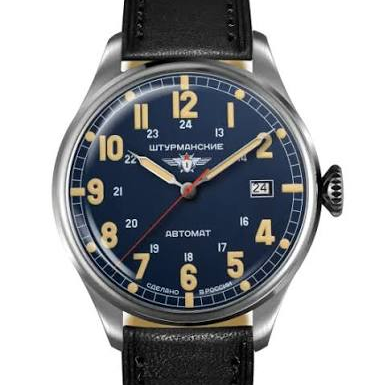
Arktika
History of the line
On 5 January 1956 the first Soviet explorers landed on the coast of Antarctica, launching the USSR's programme of polar expeditions. According to the available sources, in that same year the First Moscow Watch Factory developed the first watch designed for the specific needs of polar explorers: a 24-hour dial, on which the hour hand makes one full turn over the course of the day instead of the usual two. The solution grew out of a very practical problem — during the polar night or polar day, without the natural alternation of light and darkness, explorers needed a reliable reference so as not to lose track of time.
The 1960 catalogue presents five variants of this watch under two main names: "Antarctida", showing a ship off the coast, and "Severny Polyus" (North Pole), with a ship pictured beneath the northern lights. Both models were powered by the manual ЧН-47М calibre, with 17 jewels and a power reserve of more than 34 hours.
The design has returned to production in the current Sturmanskie catalogue with the "Arktika Heritage" collection, now offered in three variants: the Arktika Heritage 24 Hours, which faithfully revives the full 24-hour dial with the 32-jewel Vostok 2431 automatic calibre in a 42 mm case; the Arktika Heritage, with a traditional 12-hour dial and date window, powered by the Vostok 2416; and the Arktika Day-Night, with a dual 24/12-hour scale and date window, driven by the Vostok 2432. The sources consulted do not give a precise year for the relaunch of this heritage line.
Technical specifications
Main versions
The 24-hour dial is not just an aesthetic quirk: at polar latitudes, where for weeks the sun never sets or never rises at all, a conventional 12-hour dial can cause confusion about which "half" of the day you are in. A full 24-hour turn of the hour hand provides an unambiguous reference, designed specifically for people living for months without the natural alternation of day and night.