

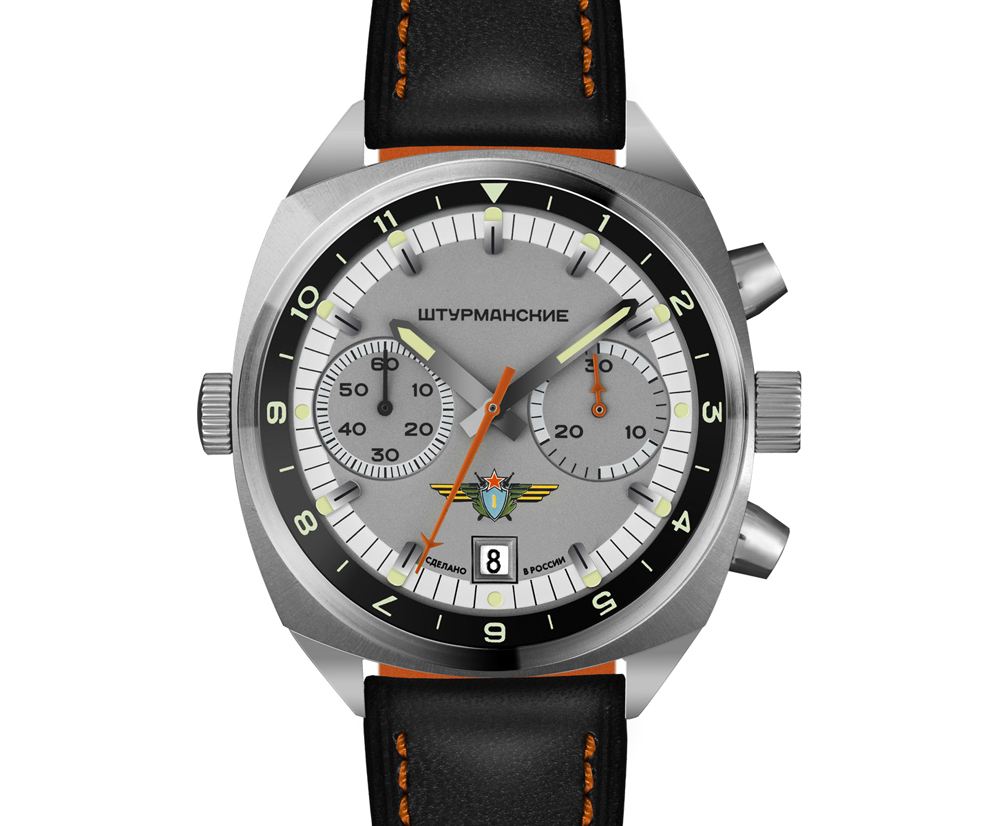
Okean
History of the line
According to the available sources, production of the Okean (Russian for "Ocean") was started in 1976 by the First Moscow Watch Factory: it was the second mass-produced Soviet chronograph not made under direct licence, after the Strela already covered on the Poljot page of this encyclopedia. Unlike the Strela, the Okean was created specifically for Soviet naval commanders and was issued exclusively to military units: it remained out of reach for civilians until 1983, when the factory also began production for retail sale.
The heart of the watch is the manual 3133 calibre, a Soviet evolution of the Swiss Valjoux 7734 produced under licence: the Moscow factory's engineers raised its frequency from 18,000 to 21,600 vibrations per hour and its jewel count from 17 to 23, resulting in a more accurate and durable column-wheel chronograph. Compared with a generic chronograph, the Okean stands out for a set of functions tailored to navigation: in addition to the chronograph with 30-minute counter and the date, the dial features a scale for reading 12 different time zones and a telemeter scale, used to estimate the distance of a visible event by measuring the gap between seeing it and hearing the sound it makes.
The name and calibre are now offered under the Sturmanskie brand in an updated form: a brushed and polished steel case 39.5 mm in diameter and 13.8 mm thick, mineral glass designed to recall the look of the plexiglass on the original 1980s pieces, a blue-silver dial with luminous indices, and a stated water resistance of 5 ATM. The sources consulted do not clearly establish whether Okean production continued between the end of the Soviet era and the recent relaunch, a grey area consistent with the scarcity of reliable documentation on this brand.
Technical specifications
Main versions
The Okean's telemeter scale made it possible, in theory, to estimate the distance to an event that can be both seen and heard — such as a gunshot or an explosion — by using the chronograph to time the interval between seeing it and hearing its sound: a function typical of mid-20th-century military and engineering chronographs, adapted here to a naval setting.