

History of the line
On 4 October 1957 the Soviet Union launched Sputnik, the first artificial satellite in history. According to the available sources, the First Moscow Watch Factory — the same manufacture that would also give rise to Poljot and Sturmanskie — responded quickly by bringing to market, in early 1958, a watch dedicated to the event: the 40ЧН model, better known as the "Sputnik".
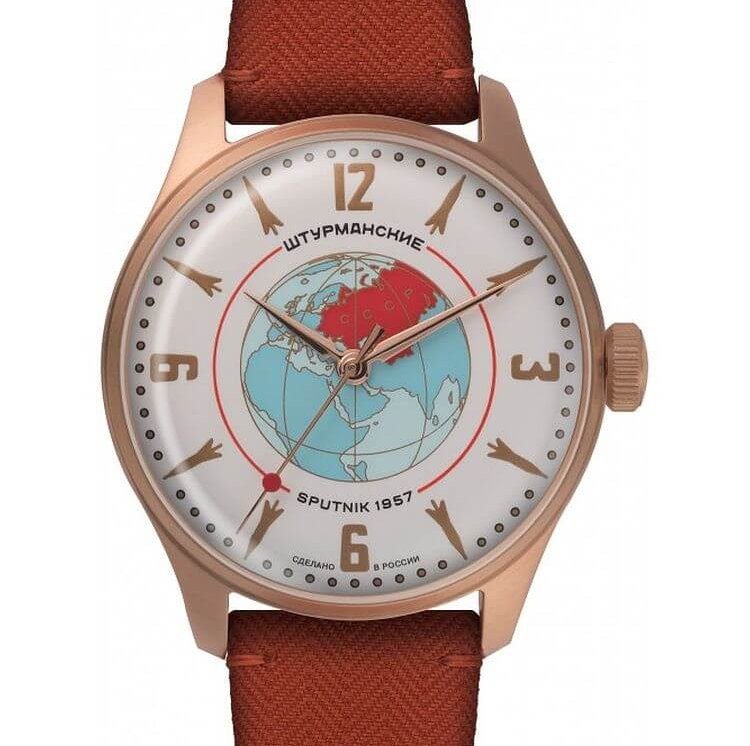
The original dial is among the most unusual in all of Soviet watchmaking: a blue-grey globe with the borders of the USSR highlighted in red and the satellite's orbit drawn over the map; the satellite itself is shown as a red dot, or as a ruby-like stone, mounted on the seconds hand or on a rotating transparent disc. To avoid cluttering the dial further, the hour markers are drawn as small rocket silhouettes at the 1, 2, 4, 5, 7, 8, 10 and 11 positions, while conventional numerals appear at 3, 6, 9 and 12. Everything is driven by the manual ЧН-44М calibre, in a 24 mm steel case, with a steel anchor and 16 jewels, delivering over 34 hours of power reserve when fully wound.
The name and design have returned to the Sturmanskie catalogue in recent years with the "Sputnik Heritage" line, which faithfully revives the original dial's defining elements — map, orbit and rocket-shaped indices — in a 40 mm case, with a choice between the Russian manual Poljot 2609 calibre (42-hour power reserve) and the Japanese Seiko VD78 quartz. The sources consulted do not give a precise relaunch year for the heritage line, a limitation not uncommon in the documentation available on a niche brand like this one.
Technical specifications
Main versions
On the original dial the satellite is not just a fixed drawing: in the more elaborate versions it is represented by a small rotating transparent disc or a ruby-like stone fitted to the seconds hand, so that it visibly "orbits" the globe with every turn of the dial — a mechanical storytelling detail that was quite rare for a Soviet watch of the period.