

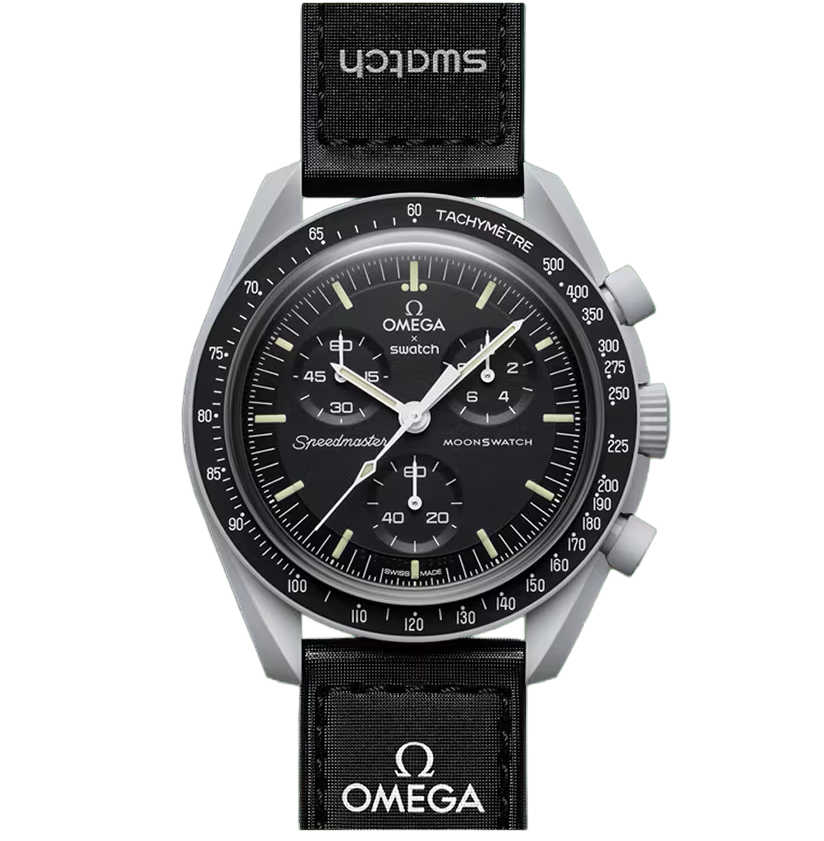
MoonSwatch
Model history
On 26 March 2022, with almost no advance notice, Swatch and Omega — two brands of the same Swatch Group — jointly unveiled the Bioceramic MoonSwatch Collection: a reinterpretation in bioceramic, a composite material made two-thirds of ceramic and one-third of a castor-oil-derived biopolymer, of the legendary Omega Speedmaster Professional "Moonwatch", the watch worn by astronauts on the Apollo missions. Eleven models were offered at launch, each dedicated to a body of the solar system — from the Moon to Mercury, Venus, Earth, Mars, Jupiter, Saturn, Uranus, Neptune, Pluto and the Sun — with the "Mission to the Moon" model as the version most faithful to the original Speedmaster design.
Launch day turned into a global event: long queues formed outside Swatch boutiques all over the world, the purchase limit per person was cut from two pieces to one to contain demand, and significant mark-ups over the list price of about 250 Swiss francs quickly appeared on the secondary market. The New York Times would describe the operation as one of the most significant moments for the entire watch industry in 2022.
The MoonSwatch's impact went beyond direct sales: according to figures reported by Bloomberg, the attention it generated contributed to a rise of around 50% in sales of the original Omega Speedmaster itself. Initially conceived as a one-off, the project became an ongoing collection, expanded in the following years with new "missions" — including the Mission to the Moonphase — and served as the model for the group's subsequent internal collaboration with Blancpain on the Scuba Fifty Fathoms.
Technical specifications
Main versions
Despite its obvious resemblance to the Speedmaster, Omega and Swatch have always presented the MoonSwatch not as a mere "cheap version" of the Moonwatch, but as a product in its own right, distinct in materials, mechanics and positioning — though born, like the Swatch brand itself in 1983, from the idea of making a watchmaking icon accessible.