

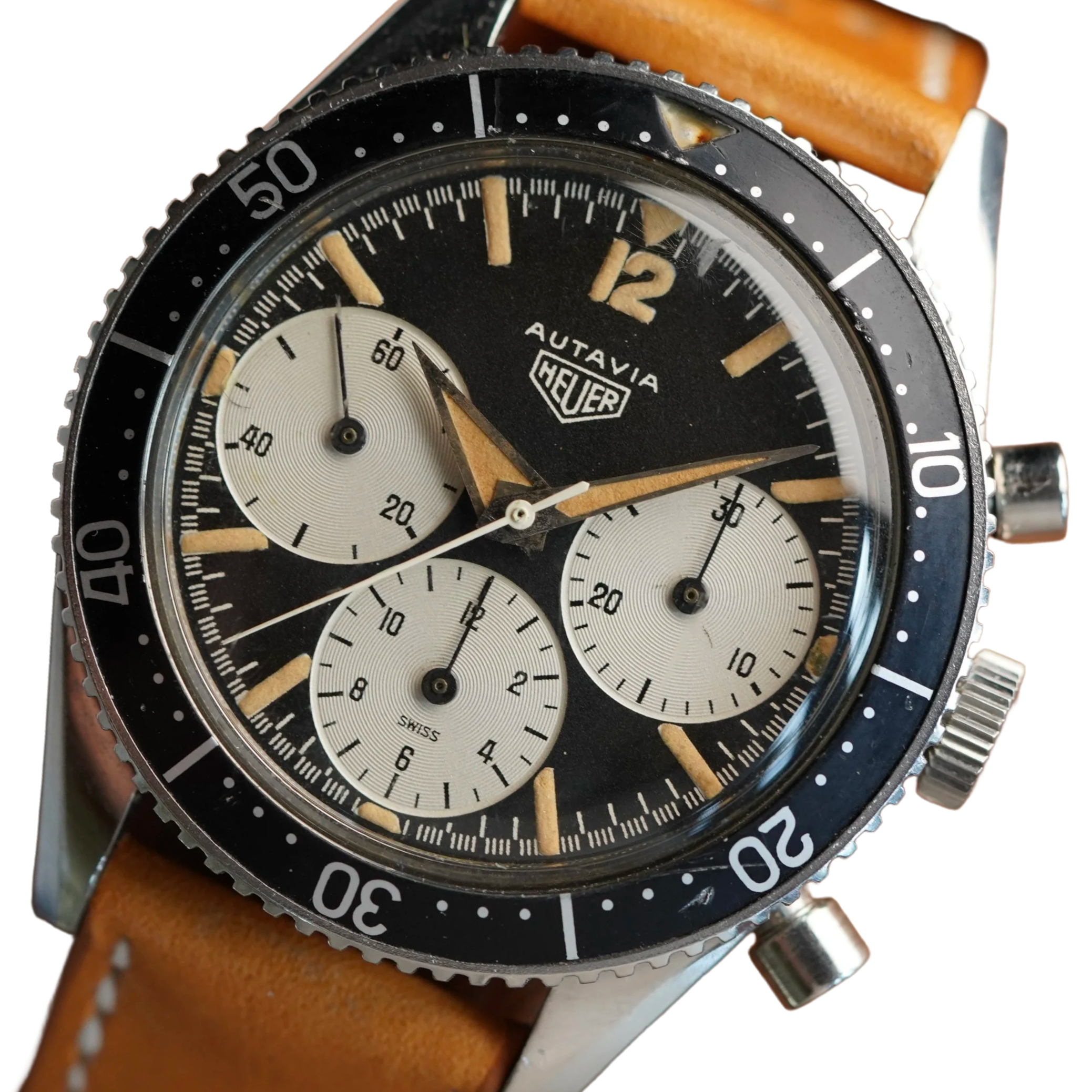
Autavia
History of the line
The "Autavia" name was born long before the wristwatch that bears it today: in 1933 Heuer used it for a 12-hour dashboard timer, designed to meet the precision needs of the automotive and aviation industries — hence the contraction of AUTOmobile and AVIAtion. For almost thirty years "Autavia" remained linked to these on-board instruments, not to a wrist chronograph.
The change came in 1962, when Jack Heuer — recently placed at the head of the company and a racing enthusiast himself — revived the name to launch a new wrist chronograph with a graduated rotating bezel, designed for racing drivers and pilots: it was the first chronograph in Heuer's history to receive a proper name, rather than being identified only by its reference number. The initial models were ref. 2446, with three counters, and ref. 3646, with two counters, both powered by Valjoux manual calibres; the rotating bezel, available with a 60-minute or 12-hour scale, became the hallmark of the line, useful for timing pit stops or flight times.
The link with motorsport quickly grew stronger: a survey of Formula 1 and IndyCar drivers in the late 1960s named the Autavia as one of the most worn chronographs on the grid, and names such as Mario Andretti became regular wearers. From 1969 the line also adopted automatic movements (Calibre 11, 12 and 15), and over more than twenty years of production, until 1985, more than two hundred different variants of cases, dials and bezels were made. After a long absence from the catalogue, TAG Heuer brought the Autavia back to market with reissues faithful to the original spirit, including a 2017 version chosen directly by collectors through a public vote among several vintage cases.
Technical specifications (1962 model)
Main versions in the history of the line
A 1968 survey of professional Formula 1 and Indianapolis drivers named the Autavia as the most common chronograph on their wrists, an accolade the brand has often recalled to illustrate the line's genuine link with the motorsport of the time.