

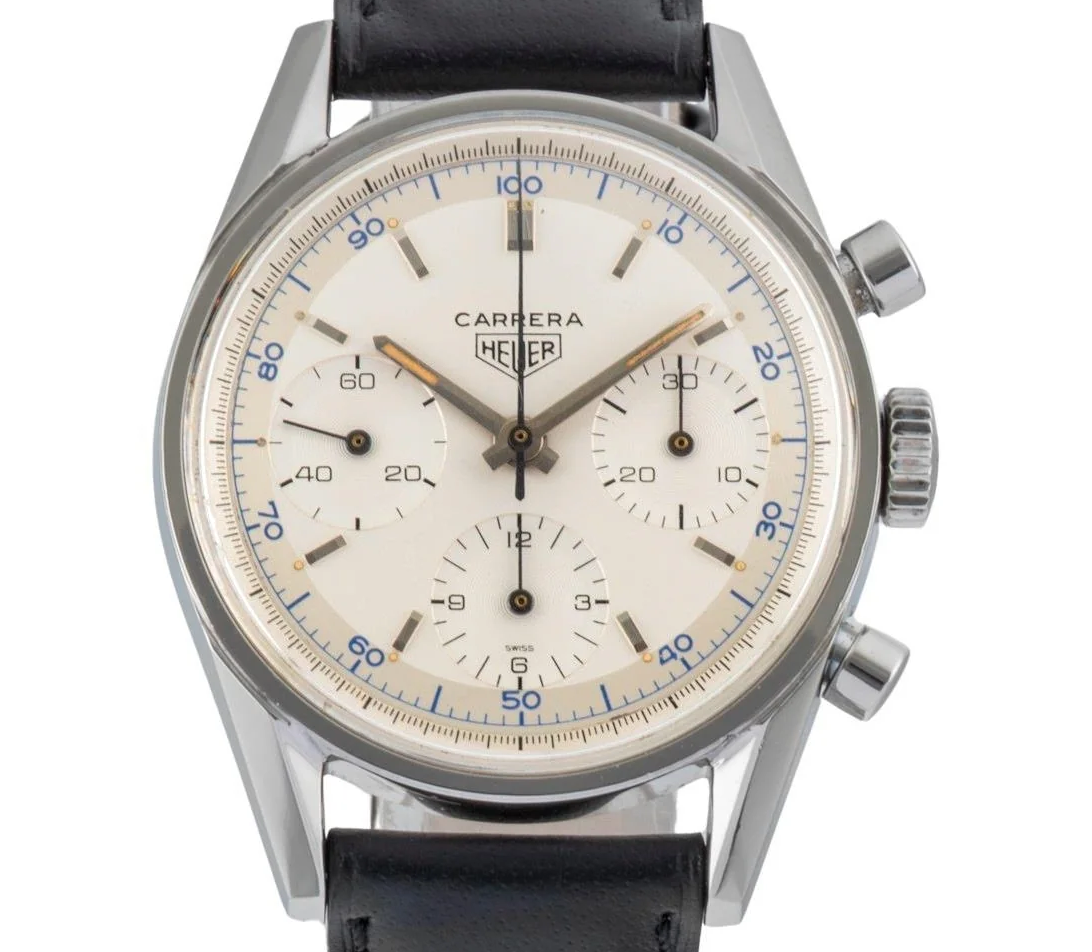
Carrera
History of the line
In 1962 Jack Heuer, the founder's great-grandson, newly appointed to head the company, met racing driver brothers Pedro and Ricardo Rodriguez in the pits at the Sebring 12 Hours. They told him about the Carrera Panamericana, the open-road race that between 1950 and 1954 had crossed Mexico from border to border over more than 3,500 km, with minimal safety measures and a death toll that led to its cancellation. The race had not existed for years, but the name struck Jack Heuer, who registered it for a new chronograph on his return to Switzerland.
The result, presented in 1963, was the Heuer Carrera ref. 2447: a 36 mm steel case with a faceted bezel — a stylistic feature the line still retains today — and a dial designed specifically for maximum legibility during a race, with applied indices and recessed counters, free of any superfluous element. Unlike the contemporary Autavia, the Carrera was conceived as a "clean", elegant chronograph rather than a dashboard instrument. Several variants were made — with two counters (ref. 3647) and three (2447), with or without a date function — powered by the Valjoux 72 and 92 manual calibres.
In 1969 the Carrera adopted the Calibre 11 "Chronomatic", one of the first automatic chronograph movements in history, developed by Heuer together with Breitling, Hamilton-Büren and Dubois-Dépraz. Like much of Swiss mechanical chronograph making, the line went through a difficult period during the quartz crisis of the 1970s and '80s, before being relaunched by TAG Heuer in 1996 with the "CS" series, faithful to the original proportions. 2015 brought the Carrera Heuer-01, with a modular case in composite materials and the integrated Heuer 01 chronograph calibre, followed by later generations with in-house manufacture movements (Calibre Heuer 02) and increasingly contemporary cases, up to the recent 39 mm reissues that recall the 1963 look more explicitly.
Technical specifications (1963 model)
Main versions in the history of the line
For decades the "Carrera" name has coexisted, without conflict, with Porsche's sports line of the same name: both companies took it from the same Mexican race, Heuer for its watches in 1963 and Porsche for its cars since the 1950s, with the two brands eventually entering an official collaboration in recent times.