

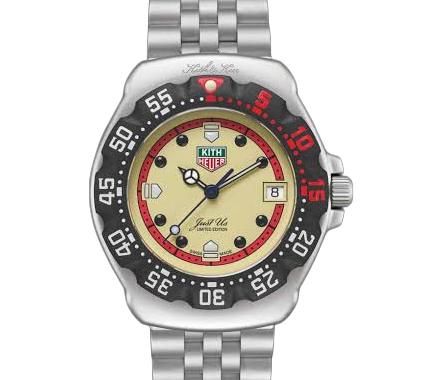
Formula 1
History of the line
In 1986, the year after Heuer was acquired by the Techniques d'Avant-Garde group and the "TAG Heuer" name was born, the brand launched the Formula 1: the first collection conceived entirely under the new ownership. Its aim was openly different from that of the historic steel-and-leather lines: to bring motor-racing-inspired sports watchmaking to an accessible price, with polycarbonate and fibreglass cases available in a range of bright colours, a quartz movement and rubber straps.
The name was no accident: in those very years TAG (Techniques d'Avant-Garde) was linked to the world of Formula 1 through sponsorship and its involvement in the "TAG Turbo" engine project built by Porsche for the McLaren team, with which Niki Lauda won the drivers' title in 1984 and Alain Prost in 1985 and 1986. The Formula 1 collection quickly became one of TAG Heuer's best-selling products in the second half of the 1980s, broadening the brand's audience well beyond fine watchmaking enthusiasts.
Over the following decades the line evolved: from the 1990s the synthetic cases were joined by steel versions; chronograph variants arrived alongside the three-hand models, and in the 2000s and 2010s came ceramic bezels and diameters updated to contemporary trends. While remaining the most accessible collection in the TAG Heuer catalogue, the Formula 1 has continued to be the ideal entry point to the brand, keeping a direct link with the discipline that gave it its name.
Technical specifications (1986 model)
Main versions in the history of the line
The TAG group that acquired Heuer in 1985 was no stranger to Formula 1: it had direct ties with McLaren, for which Porsche developed the "TAG Turbo" engine on commission, with which the team won three consecutive drivers' titles in the mid-1980s.