
Monaco
History of the line
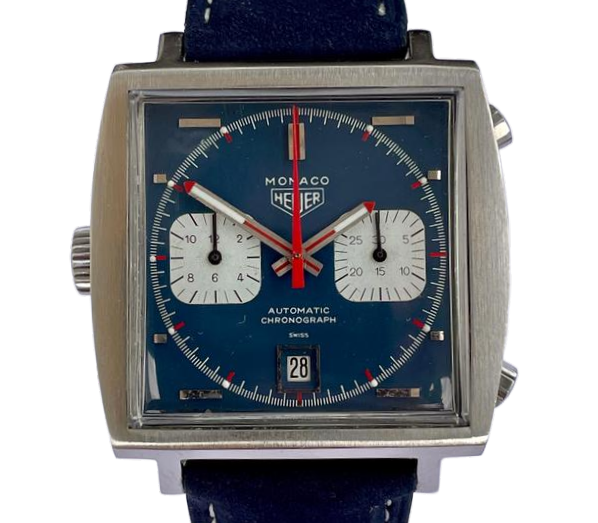
On 3 March 1969 Heuer simultaneously presented the Monaco in Geneva and New York, named in honour of the Principality's Formula 1 Grand Prix. It was no ordinary launch: the watch was fitted with the Calibre 11, developed in a consortium with Breitling, Hamilton-Büren and Dubois-Dépraz and also known as the "Chronomatic", one of the very first automatic chronograph movements in the world — Heuer, Zenith (with the El Primero) and Seiko all claimed this first almost simultaneously in the same year. What made the Monaco truly unique, however, was its case: square, steel and water-resistant, a combination no chronograph had ever offered before.
The first reference, the 1133, was produced in two dial variants — blue with white counters (1133B) and metallic grey (1133G) — and featured a detail that betrays the particular architecture of the Calibre 11: the crown is on the left side of the case, rather than on the right as is customary, because the side-mounted micro-rotor movement frees up space on that side. In 1971 the Monaco entered popular culture thanks to Steve McQueen, who wore it in the film "Le Mans": guided by advice from racing driver and Heuer ambassador Jo Siffert to make his performance authentic, the actor chose a Monaco with calibre 12 for the role.
Production stopped in the mid-1970s, a victim of the quartz crisis that hit the whole Swiss mechanical watch industry. TAG Heuer brought the Monaco back into the catalogue in 1998, and again in 2003 with updated automatic calibres, riding the McQueen legacy that had meanwhile become legendary among collectors. 2004 brought the Monaco V4, a concept watch with a miniature belt drive instead of traditional gears, followed in later years by numerous special editions — including versions in the light blue and orange Gulf livery — that continue to play on the legacy of the 1969 design.
Technical specifications (1969 model)
Main versions in the history of the line
In 1969 Heuer was not the only one to claim the first automatic chronograph: that same year Zenith presented the El Primero and Seiko its own calibre 6139, sparking a three-way race that watchmaking history still remembers as one of the most intense technical contests in the industry.