

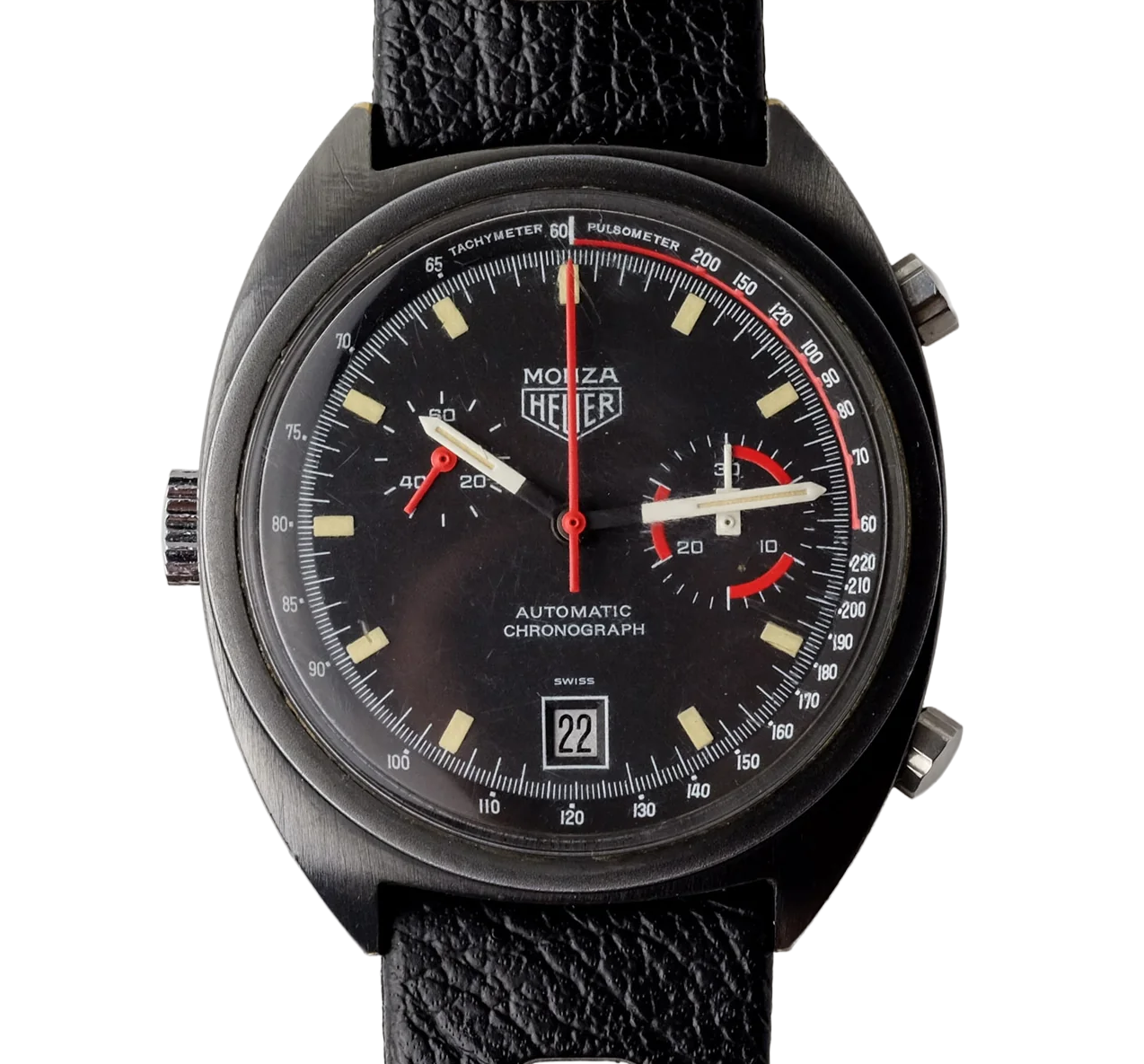
Monza
History of the line
In 1975 Scuderia Ferrari returned to the top of Formula 1 thanks to Niki Lauda, who won the drivers' title in a season in which the Italian constructor also took the constructors' title. Heuer, already linked to the world of Formula 1 through its timing instruments and the "Centigraph" system developed for Ferrari itself, decided to celebrate the success with a new chronograph: it named it "Monza", after the circuit near Milan that hosts the Italian Grand Prix, where Lauda had sealed the title. The watch debuted in 1976.
The Monza immediately stood out for a feature that was revolutionary for the time: it was the first watch in Heuer's history with an all-black case, thanks to a PVD treatment on an asymmetric barrel-shaped steel structure, a sharp break with the polished steel that then dominated sports watchmaking. The movement is the automatic Calibre 15, and the black dial with white counters reinforces the model's essential, "racing" character, alongside — in the family of barrel-shaped cases of those years — other Heuer models such as the Monaco, the Silverstone and the Jarama.
Like many Heuer lines, the Monza had a short production life: the quartz crisis and the subsequent change of ownership to TAG in 1985 brought production to a halt after a few years. TAG Heuer has, however, brought it back to life several times: an automatic reissue in 2000, and above all a Monza Flyback Chronograph in 2016, for its fortieth anniversary, with titanium cases and ceramic components. In 2026, exactly fifty years after the 1976 launch, the brand presented a new edition of the Monza Flyback Chronograph in forged carbon, confirming the line's role as one of the most direct bridges between the Heuer heritage and TAG Heuer's motorsport identity.
Technical specifications (1976 model)
Main versions in the history of the line
Before the Monza, Heuer chronographs were almost always finished in polished or satin-finished steel: the choice of a completely black case in 1976 was seen as radical, and anticipated by decades a trend — PVD- or DLC-treated cases — that would become common in sports watchmaking only many years later.