

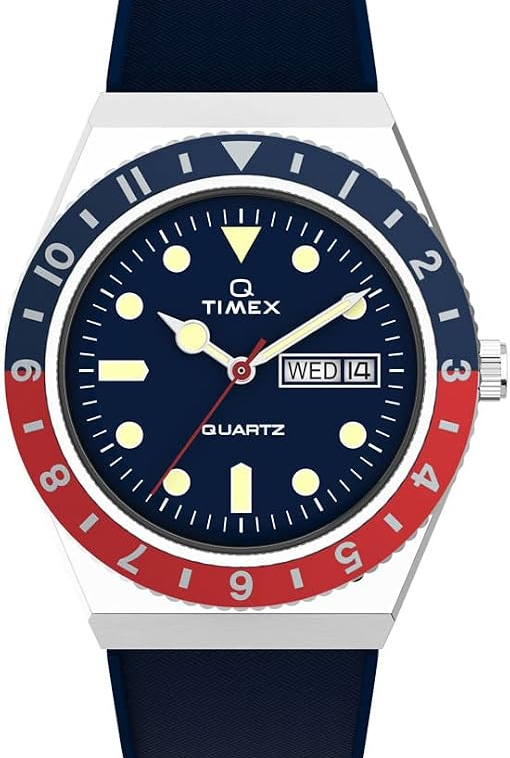
Q Timex
History of the line
The Q Timex was born in 1979 as Timex's response to the quartz revolution that had upended the traditional watch industry in the 1970s. Unlike many competitors of the time, which tended to hide the electronic side of their watches, the Q Timex put it openly on display: a blue dial with day-date window, a colourful twelve-hour rotating bezel openly inspired by the Rolex GMT-Master, a light mesh bracelet and an easily accessible battery hatch, conceived as a distinctive detail rather than a mere technical necessity.
After years out of the catalogue, in 2019 Timex relaunched the Q Timex with a faithful reissue of the 1979 model, achieving commercial and critical success beyond expectations. According to Giorgio Galli, design director of Timex Group, this model was chosen for a relaunch because its design language and history, in the company's words, truly had a story to tell, showcasing typical 1970s design elements and the original colourways.
The success of the Q Timex 1979 quickly led to an expansion of the line, with variants such as the Falcon Eye, inspired by a 1978 model, and the M79, with a mechanical movement, as well as special collaborations such as the one with Hodinkee: the Q Timex thus became a permanent collection of the brand, dedicated to celebrating Timex's heritage in quartz watchmaking.
Technical specifications
Main versions
While many 1970s quartz watches tried to disguise their electronic nature by imitating traditional mechanical aesthetics, the 1979 Q Timex did the exact opposite, with a battery-replacement hatch clearly visible on the dial: a detail that is faithfully reproduced in the 2019 reissue too.