

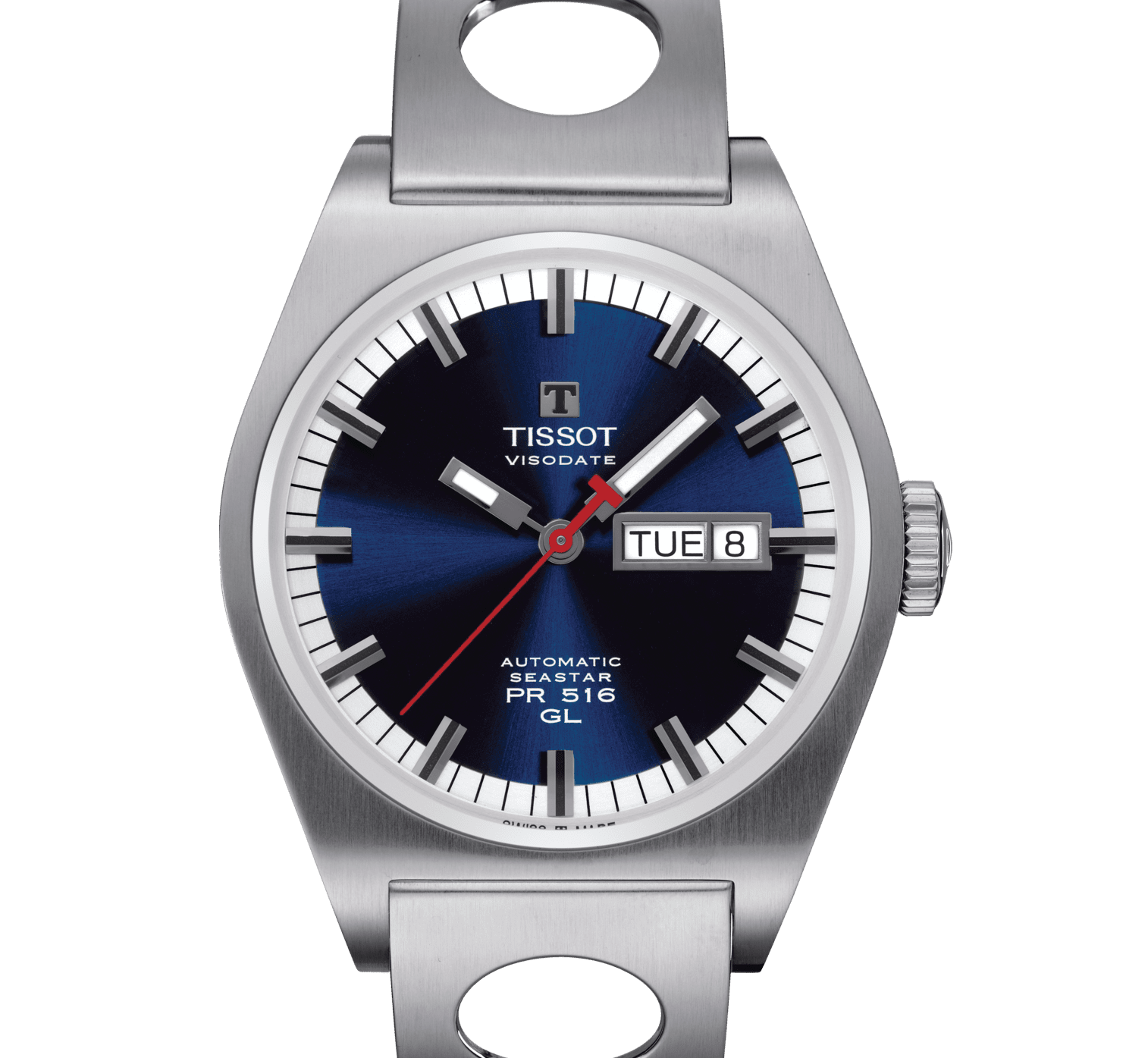
Model history
The PR 516 joined the Tissot catalogue in 1965, as part of the wider Seastar family of watches designed for shock and water resistance. Sources differ slightly on the exact meaning of the initials — some trace them to "Precision" and "Resistance", others to "Particularly Robust" — while the most common reading of the number "516" is a series code, with the "5" indicating the water-resistant line and the "16" the sixteenth reference in that series. Technically, the model introduced a "floating" movement suspended on elastic joints in synthetic material that absorbed shocks, combined with an armoured crystal set deep into the case to improve water-tightness.
The PR 516's success is also tied to one of the most memorable advertising campaigns in the brand's history: from 1966, the image of a gloved racing hand on a steering wheel accompanied the slogan "On the track, in the air, in the water — everywhere", a campaign which, according to Tissot's historical archives, ran for five years in more than 150 countries and won several awards in the advertising industry. The link with motorsport, evoked more in the marketing than in a strictly technical sense, was strengthened in 1968 with the arrival of the Chrono version: three counters for hours, minutes and seconds, a tachymeter scale and a blue triangle designed for calculating average times in rally timing.
Unlike the PRX, which went out of production and was rediscovered decades later, the PR 516 never really left the Tissot catalogue: its 1970s-style sports chronograph design has been revived several times in editions that recreate the original look, in both mechanical and quartz versions, maintaining continuity with the 1965 model without the "archive rediscovery" interlude that instead characterised the PRX relaunch.
Technical specifications
Main versions
The 1966 advertising campaign showing a gloved hand on a racing steering wheel, with the slogan "On the track, in the air, in the water — everywhere", ran for five years in more than 150 countries and won several industry awards, according to the brand's historical archives: a rare case of an advertising campaign becoming almost more famous than the watch itself.