

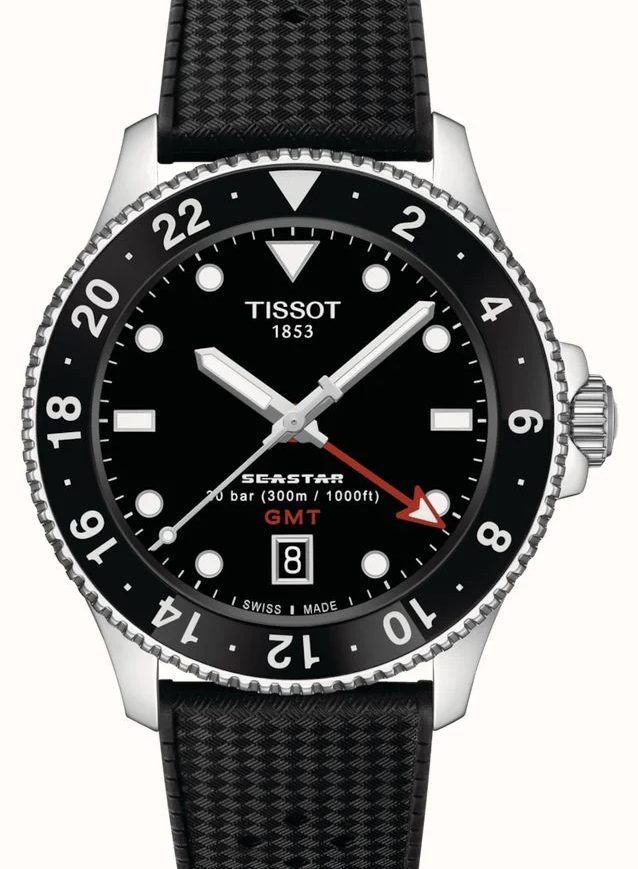
Seastar
Model history
The Seastar name was registered as a trademark by Tissot in 1952, at the end of a series of water-resistance experiments the company had been conducting since the 1930s and '40s with models such as the "Camping" (1938) and "Aquasport" (1939). The line was born with a clear goal: to offer a rugged sports and dive watch, with stainless steel cases, crystals described as "unbreakable" for the time and resistance to both shocks and magnetic fields, designed for sportspeople, swimmers and mountaineers.
Among the line's most frequently cited historic references is the 1956 Seastar T12, water-resistant to 120 metres: some industry sources associate it with Commander Jacques-Yves Cousteau and with mountaineer Nawang Gombu, who is said to have worn it during his 1963 ascent of Everest — anecdotes widespread among enthusiasts and repeated in several articles, but not confirmed by direct official documentation from the brand, which is why we report them with the caution any source we cannot verify first-hand deserves. In the following decades came the Seastar Seven with a slimmer monocoque case patented in 1963, the 1973 Seastar Automatic and the 1978 Seastar Quartz, which brought quartz technology to the line.
From the early 2000s the line evolved into the Seastar 1000 Automatic (from 2003), now also offered in a Powermatic 80 version: a dive watch with a more distinctly sporty character than the original models, but still one of the "core" collections of the current Tissot catalogue — testament to the long continuity of a name that has accompanied the brand, in various forms, since 1952.
Technical specifications
Main versions
Several industry articles report that the 1956 Seastar T12 was worn by Commander Jacques-Yves Cousteau and by mountaineer Nawang Gombu during the 1963 Everest expedition: anecdotes that recur in the vintage watch community but are not confirmed by direct sources from the brand, and should therefore be treated with due caution.