

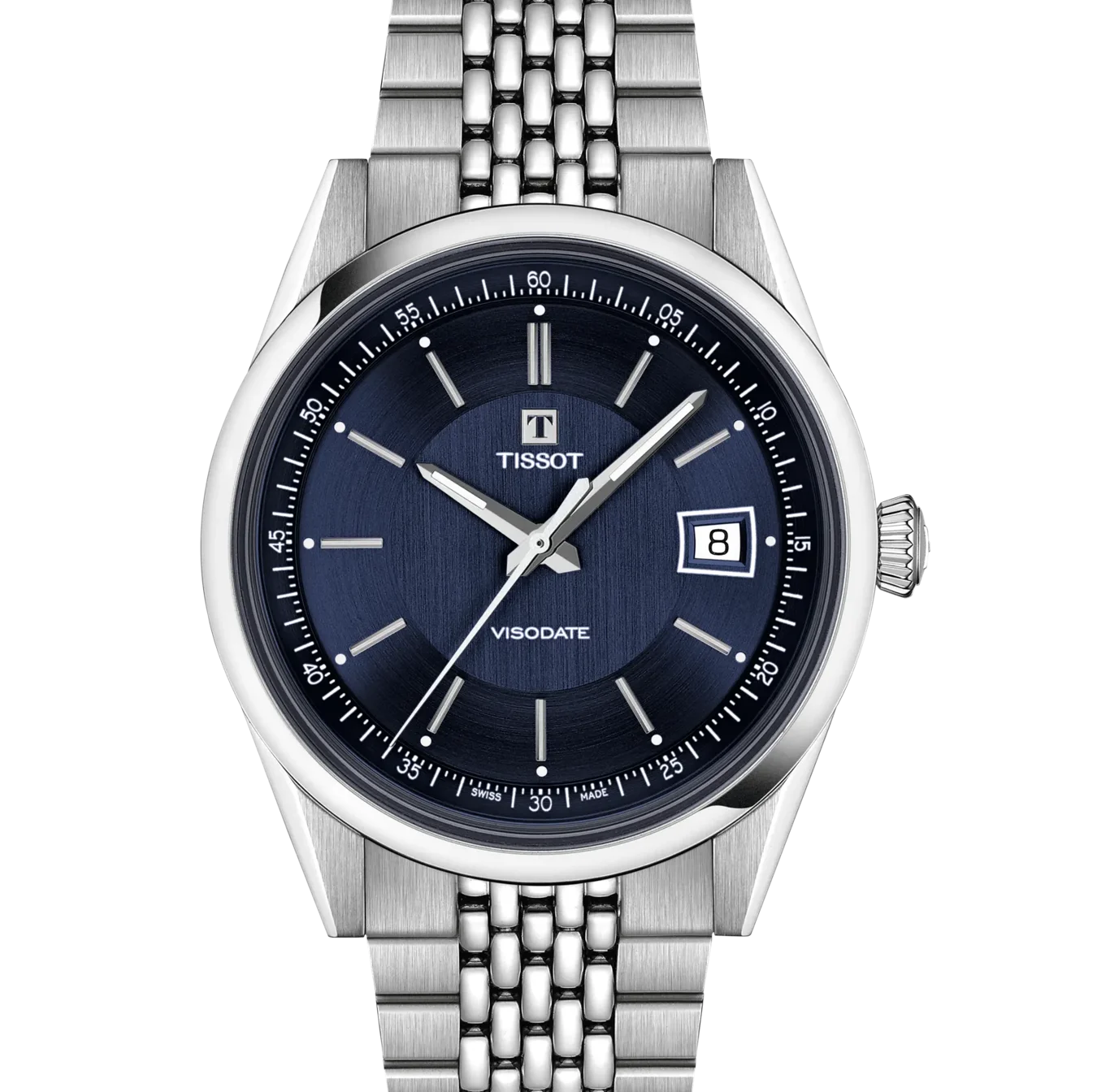
Model history
The Visodate was presented by Tissot in 1954 with a name that is already a small manifesto: a fusion of "visible" and "date", referring to a small calendar window designed to be read at a glance. The technical feature the brand associates with the model is a mechanism that makes the date numeral jump instantly at midnight, rather than letting it creep gradually over the preceding hours as happened with several automatic calendars of the time — an improvement on Tissot's own earlier attempts, such as the 1940s Calendrier and the 1953 Centenary.
Sources do not fully agree on this first: some in-depth industry pieces place the Visodate's instantaneous date jump in relation to Rolex's Datejust — which introduced the automatic calendar in 1945 but only achieved an instantaneous change from 1955 — describing the Visodate as arriving "less than a decade" after the Rolex pioneer, while other secondary sources present Tissot as earlier with the instantaneous change. The brand's official documentation does not explicitly claim absolute priority, so on this specific point we simply note the disagreement between sources rather than stating it as a definite first.
The Visodate name and design have been revived several times in the following decades: a first wave of "Heritage" relaunches offered automatic versions with the ETA 2836-2 movement, a case of around 40 mm and a sapphire display caseback (instead of the original acrylic crystal); a more recent Visodate collection further updated the design with the Powermatic 80 movement, a Nivachron hairspring and a more compact 39 mm case, offered in various dial and strap combinations, confirming the vitality of a name born more than seventy years ago.
Technical specifications
Main versions
The name "Visodate" is literally a small slogan built into the model's name: it fuses "visible" and "date" to describe in a single word the watch's central promise, a rather unusual naming device for 1950s Swiss watchmaking.