

History of the line
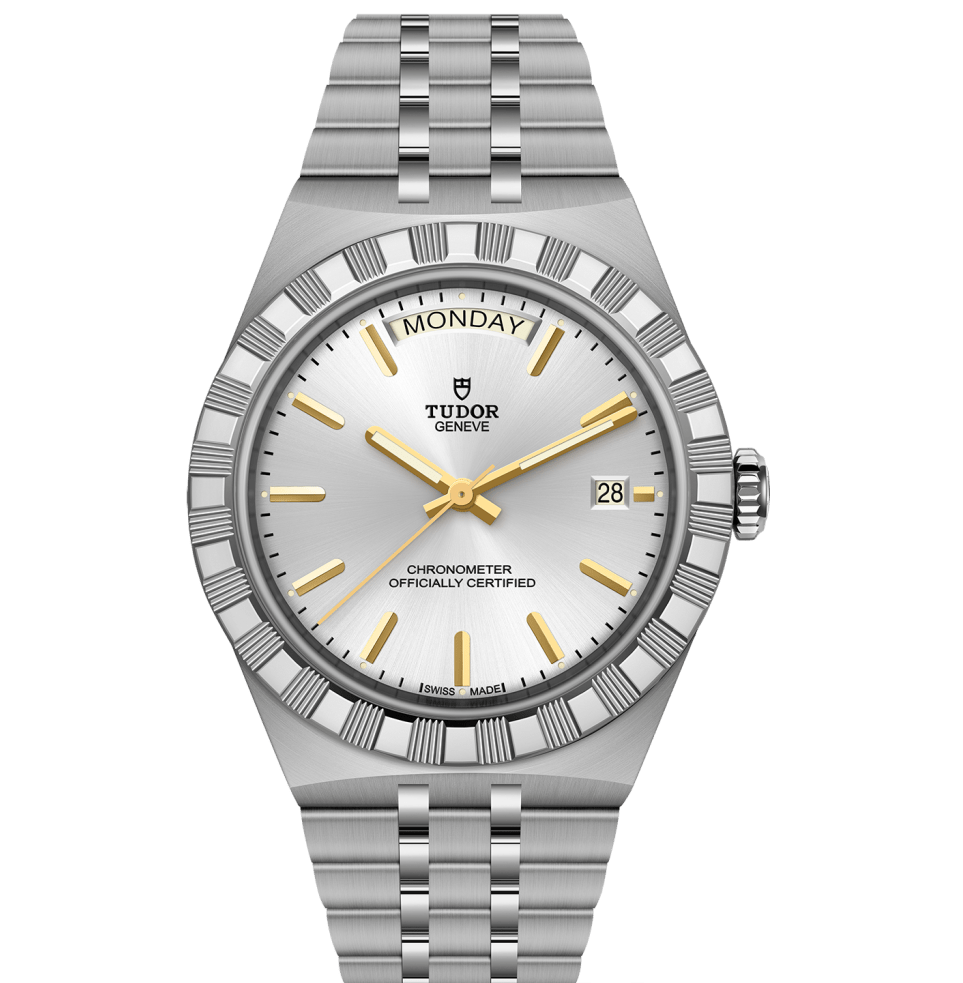
The Royal debuted in 2020 as Tudor's answer in the segment of elegant everyday watches, a territory the brand had already occupied in the past with lines such as the Prince Oysterdate (introduced in 1995, itself heir to the Prince family begun in 1952 with the Oyster Prince). Its distinctive feature is the integrated five-link bracelet, with alternating polished and satin finishes, and a "notched" bezel that visually recalls — in a reading widespread among enthusiasts — the style of the fluted bezel on the Rolex Datejust. The collection is offered in four case sizes — 28, 34, 38 and 41 mm — to cater to both men and women.
Mechanically, the Royal uses movements from outside suppliers rather than in-house calibres: the Sellita SW240-1 for the 41 mm case, the Sellita SW200-1 for the 34 and 38 mm sizes and the ETA 2671 for the 28 mm. This choice is consistent with the logic that has historically defined the relationship between Tudor and Rolex — the same design codes, simpler movements — applied here to a product designed to remain accessible.
The wide choice of dial colours and finishes, including diamond-set versions in the smaller sizes, makes the Royal the offering closest to jewellery watchmaking in the Tudor catalogue, in sharp contrast with the tool-watch spirit of the Black Bay, Pelagos, Ranger and North Flag: confirmation of how today's Tudor catalogue brings together both tool watches with military roots and elegant models with integrated bracelets.
Technical specifications
Notable references
The Royal's notched bezel is often described by enthusiasts as a visual reference to the famous fluted bezel of the Rolex Datejust: a comparison Tudor does not officially make in these terms, but which reflects well how the two brands, though now fully independent in design, continue to share a certain family design vocabulary.