

Astrolabium
History of the line
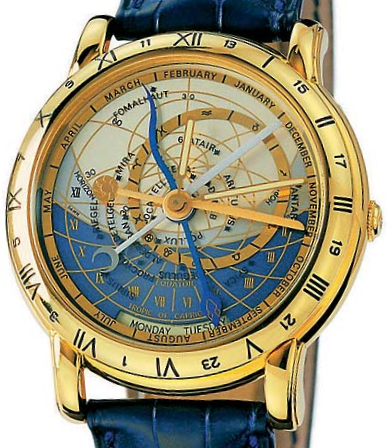
Presented at the Basel Fair in 1985, the Astrolabium Galileo Galilei was the first fruit of the collaboration between Rolf Schnyder, who in 1983 had taken over Ulysse Nardin, saving it from the near-bankruptcy that followed the quartz crisis, and Ludwig Oechslin, a young watchmaker and mathematician. After studying the mechanics of an ancient mechanical astrolabe, Oechslin managed to transfer its workings mathematically into a compact wristwatch movement: a feat that immediately astonished the international watchmaking community with its technical ambition and degree of miniaturisation.
Within just 40 mm in diameter, the calibre contains a planispheric projection of the starry sky, the position of the sun and moon above or below the horizon, the signs of the zodiac and the months, sunrise and sunset times, moon phases and even the prediction of solar and lunar eclipses by means of the so-called "dragon hand". The calculation behind the astrolabe mechanism ensures an accuracy that accumulates just one day of error every 144,000 years; the original version was calibrated for a latitude of 46° north.
The Astrolabium opened what would later be called the "Trilogy of Time": the series of astronomical complications completed by the Planetarium Copernicus in 1988 and the Tellurium Johannes Kepler in 1992, all designed by Oechslin. This triptych marked the real rebirth of Ulysse Nardin as an independent manufacture capable of haute horlogerie after the difficult years of the quartz crisis, and it remains one of the most cited chapters in the brand's history.
Technical specifications
Timeline of the line
The name pays tribute to Galileo Galilei, in keeping with Oechslin's decision to dedicate each of the three complications of the Trilogy of Time to a scientist who shaped the history of astronomy: after Galileo came Copernicus, with the Planetarium, and Kepler, with the Tellurium.