

Marine
History of the line
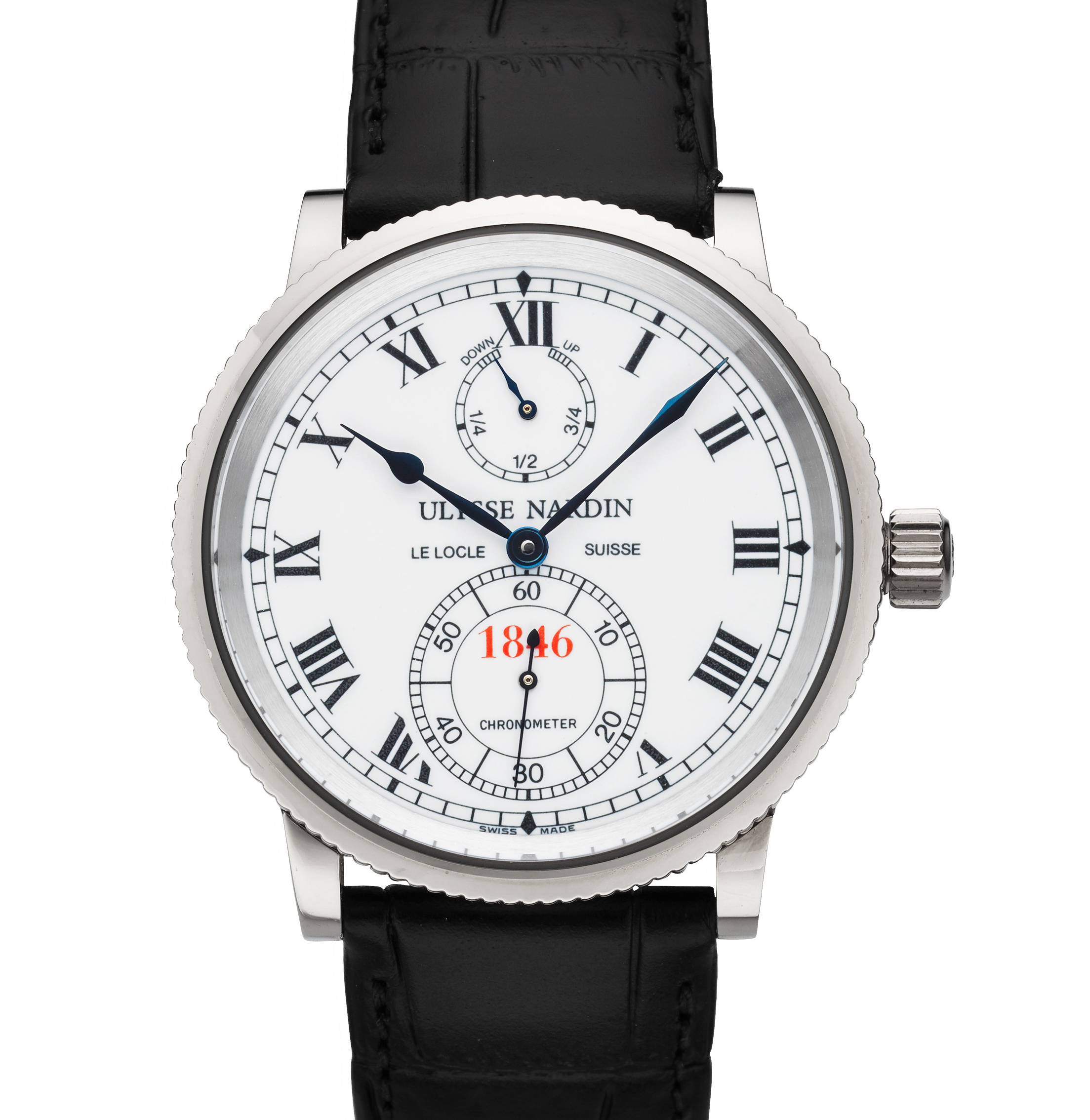
The Marine collection was born in 1996, for the 150th anniversary of the manufacture's founding, with the Marine Chronometer 1846: a 38.5 mm wristwatch, available in steel or yellow gold, whose enamel dial reproduces in miniature the look of a period marine chronometer, with the numerals "1846" in red and distinctive fluting on the side of the case. The movement, based on an ETA 2892 calibre with official C.O.S.C. certification, anchored the new model in the chronometric tradition that had made Ulysse Nardin famous since the 19th century.
In the following years the line expanded with larger, sportier versions, often referred to as "Maxi Marine", also designed for diving, and with the introduction of in-house calibres (such as the UN-118 family) that gradually replaced externally sourced bases. The range also gained navigation-oriented complications: dual time zone, annual calendar, chronograph and moon phases, as well as integrated silicon components to improve accuracy and resistance to magnetism.
In 2017 the line was further extended with the Marine Torpilleur, a time-only version with a more understated, military-inspired design, aimed at a wider audience than the complication versions. The Marine collection remains today the main direct heir, aesthetically and conceptually, of the on-board chronometers that had made the fortune of the Le Locle manufacture.
Technical specifications
Timeline of the line
The line's name refers directly to the marine chronometer, the instrument kept in a box on board ships and used to calculate longitude through astronomical navigation: it was precisely the production of these instruments, from the mid-19th century, that made Ulysse Nardin a benchmark name for many navies around the world.